
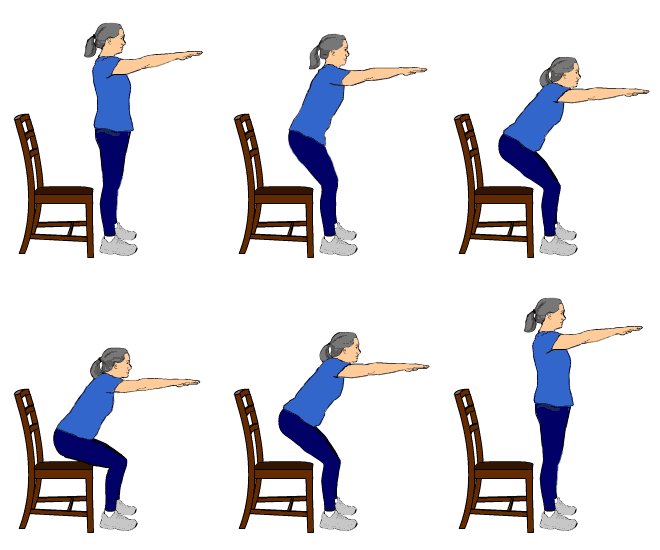
A squat is a lower-body movement that involves bending the hips and knees and returning to a standing position. It resembles the ordinary task of sitting down and getting up, but exercise versions vary in depth, resistance and support. This guide explains how to select a manageable version, practise controlled movement and increase the challenge without treating one technique as suitable for every body.
Start with a stable chair or a suitable supported bodyweight squat if you can perform it safely. Use a comfortable foot position, bend your hips and knees together, maintain control and return to standing. Choose a depth that suits your abilities. Build repetitions or resistance gradually rather than forcing a deep squat. Persistent pain, instability or difficulty transferring warrants appropriate professional assessment.
Understand What The Squat Trains
The squat uses several muscles to control the movement of the body against gravity. The muscles around the knees and hips contribute to lowering and rising, while the trunk and other regions help maintain a controlled position. The exact demands change with the movement depth, foot position, external resistance and the person’s body proportions.
A chair rise is a practical example of a squat-like movement. It involves transferring from a seated position to standing. An unsupported bodyweight squat is different because the person controls the entire descent without relying on a seat. A loaded squat introduces another demand. These exercises are related, but their starting difficulty can differ considerably.
A person might practise squats to improve a general resistance routine, make familiar daily movements easier or prepare for another activity. Those goals do not require identical techniques or workloads. Someone learning a comfortable chair rise may have no need for a barbell squat. A strength athlete, in contrast, may eventually need specific coaching and equipment.
Our beginner strength training guide explains how to select an appropriate resistance routine. The squat is one possible exercise within that broader program, not a mandatory test of physical fitness. If another movement provides an appropriate and more accessible challenge, it can be a useful alternative.
Choose A Suitable Starting Variation
Before practising, consider whether you can stand and sit safely during ordinary daily activities. A person who requires assistance or uses a prescribed mobility aid should follow professional instructions rather than attempting an unsupported squat on the basis of an online demonstration. Previous surgery, injury or significant balance difficulty may require individualized exercise selection.
If a chair squat is suitable, choose a firm chair with no wheels and a stable base. The chair should not slide across the surface when weight is transferred. A higher seat may be easier to use than a very low seat, although suitability depends on body proportions and individual needs. Do not place loose cushions or unstable objects beneath the chair to create an improvised height adjustment.
The NHS strength exercise resource describes chair-based exercises and stable seating considerations. A supported version can provide a practical starting point for many people, but even a chair exercise may be unsuitable when transfers are not safe.
If ordinary chair rises are comfortable, you may choose a bodyweight squat with an appropriate stable support nearby. Do not use a movable chair, lightweight table or other object that could tip when pulled. A suitable support should be selected according to the person’s needs.
Our balance exercise guide explains why stability takes priority over completing an unsupported movement. A useful exercise is one that can be performed with control and repeated without unnecessary risk.
Learn A Controlled Chair Rise
Begin seated on a suitable stable chair. Place your feet in a comfortable position on the floor, with enough room to move safely. If you need assistance from your arms, use the supports appropriate to your circumstances. Do not assume that an arm-assisted chair rise is inferior simply because a demonstration uses no hand support.
For someone who can perform the exercise independently, move toward the front of the seat as appropriate, incline the trunk forward enough to transfer weight toward the feet and rise in a controlled manner. Once standing, pause if necessary to regain a comfortable position. Reverse the movement by bending the hips and knees and guiding yourself back onto the chair. Avoid dropping onto the seat.
Breathing should remain comfortable. Exhale during the demanding part of the movement if that feels natural and avoid deliberately holding your breath for prolonged periods. People with specific clinical exercise instructions should follow them.
Consider a fictional adult beginning a home routine. They perform three controlled chair rises and then rest. If the movement remains manageable and ordinary activities are unaffected, they might repeat the same exercise on another day. This is an example of a first trial, not an instruction that everyone should complete three repetitions.
The aim is to practise a useful movement with an appropriate level of challenge. If rising or sitting cannot be controlled, the correct response may be to select a higher suitable chair, use appropriate assistance or obtain an assessment. Do not increase repetition count while the fundamental movement remains unsafe.
Progress To A Bodyweight Squat When Appropriate
A bodyweight squat can be practised without a chair when the person can control the movement safely. Begin with a comfortable stance, keeping enough space around you. The feet may point forward or slightly outward according to comfort and individual anatomy. No single foot angle is correct for every person.
Bend the hips and knees together and lower through a manageable range. Keep the feet supported on the floor and allow the knees to move in a comfortable direction relative to the feet. Some forward movement of the knees is a normal part of many squat techniques. Avoid imposing a universal rule that the knees must never move past the toes.
The trunk may incline forward as the hips and knees bend. The amount of inclination varies with body proportions and the chosen squat style. Attempting to keep the torso completely vertical at every depth can make the movement awkward for some people. The important considerations are control, comfort and suitability.
At the chosen depth, reverse the movement smoothly and return to standing. Do not bounce at the bottom or deliberately descend farther than you can control. An exercise can be useful at a partial range, particularly during an introductory stage. Increasing depth is optional and should reflect the intended goal.
Our home workout guide offers a broader context for bodyweight exercises. A squat should not take up the entire session unless there is an identifiable reason. Choose a balanced program that addresses other suitable movements as well.
Adjust Depth And Stance Instead Of Forcing A Position
Individual differences influence the way a squat looks. The length of the thigh relative to the lower leg and trunk, ankle mobility, hip anatomy and footwear can affect the position that feels manageable. A person with a longer thigh may naturally use a different trunk position from another person performing a similar movement.
A deeper squat may be appropriate for some goals, but depth should not be treated as a universal measure of quality. If the feet lose stable contact with the floor or the movement becomes uncontrolled at a particular depth, reduce the range and consider whether a different variation is appropriate.
Use a mirror or recording only if it can be done safely without distracting from the exercise. A visual check can help someone notice a movement pattern, but it cannot diagnose a joint condition or establish why a movement feels difficult. A qualified exercise professional or physiotherapist can help when technique or symptoms require individual attention.
Do not assume that a particular stretching exercise will automatically make a deep squat possible. Mobility, strength, anatomy and confidence may all influence the movement. A person’s goal may not require a deeper position in the first place.
Our stretching comparison explains that mobility practices have different purposes. For squat preparation, comfortable movement and suitable practice may be more relevant than forcing a prolonged stretch. A useful warm-up prepares the person for the range they intend to use.
Select Sets Repetitions And Recovery
The amount of squat practice should fit the person’s overall strength routine. Someone beginning resistance exercise may find a small number of controlled repetitions sufficient. A more experienced person may use several sets with a suitable external load. Neither should be assumed to need an identical prescription.
For illustration, an otherwise healthy beginner who manages chair rises comfortably might try one set of five repetitions, rest and assess whether another set is appropriate. The next session could repeat that workload rather than automatically increasing it. If five repetitions are too difficult, reduce the number or select a different variation. If the exercise feels easy, there is still no obligation to make a large immediate increase.
General adult guidance describes regular muscle-strengthening activity, but it does not require squatting every day. The CDC older adult activity overview provides examples of combining strengthening, aerobic and balance activity where appropriate.
Our rest-day guide discusses how to distribute training across the week. Consider other activities involving the legs, including walking, stair climbing and household tasks. A modest exercise session may be more demanding when combined with an unusually active day.
Use a manageable effort and stop the set while you can still control the movement. Repeated maximal attempts are unnecessary for learning technique. The aim is consistent practice with sufficient recovery rather than exhausting the legs at every opportunity.
Introduce External Resistance Only When It Serves Your Goal
A bodyweight squat already involves moving the mass of the body against gravity. External resistance can increase the demand, but it also introduces the need to handle equipment safely. Consider whether additional load is necessary for the goal and whether the current variation can be controlled consistently.
A suitable dumbbell held securely may be one possible option for someone who has learned the movement and can manage the equipment. The amount should be manageable, and the person must be able to pick up and put down the weight safely. A heavier object is not automatically a better choice simply because the person can complete one repetition.
Our dumbbell comparison describes practical issues such as grip, adjustment and equipment handling. Check that any adjustable mechanism is engaged according to the manufacturer’s instructions. Do not use damaged equipment or improvised loads that can shift unexpectedly.
Barbell squat variations may require additional instruction, compatible racks and appropriate safety arrangements. They are not necessary for a beginner’s general home routine. If your goal specifically involves a barbell lift, obtain appropriate coaching rather than assuming that a bodyweight technique guide establishes competence with a loaded bar.
Our progressive overload guide explains why resistance, repetitions, range and other demands can be changed gradually. Select one useful change at a time. An exercise should remain controlled after the adjustment, and the total workload should allow appropriate recovery.
Recognize Pain And Warning Signs
Muscle effort and temporary fatigue may occur during suitable resistance exercise. Sharp pain, instability, numbness or other concerning symptoms are reasons to stop. A person should not continue an exercise simply to meet a repetition target when the movement has become painful or uncontrolled.
Persistent knee, hip or back symptoms can have several causes. A squat cannot determine the underlying diagnosis. Reducing the range or resistance may sometimes make an exercise more manageable, but recurring pain or functional difficulty deserves appropriate assessment. Do not use progressively heavier squats to investigate an unexplained symptom.
Our muscle soreness guide distinguishes typical delayed soreness after unfamiliar exercise from more serious findings. Severe muscle pain, marked weakness or dark urine requires urgent medical attention. Chest pain, fainting or severe breathing difficulty during exercise also warrants emergency assessment.
If you have been given a restriction after surgery or injury, follow the rehabilitation instructions. A public demonstration may show movements that are appropriate for a different stage of recovery. The relevant question is whether the exercise suits your own condition and current abilities.
A person who becomes dizzy when standing should stop and seek appropriate advice, especially if the symptom recurs. Do not perform repeated chair rises in an unsafe environment to test whether the dizziness disappears. Suitable exercise must account for the entire person, not merely the muscles involved in the movement.
Use A Simple Progression Record
A practical record can include the variation used, the chair height or relevant range, number of repetitions, external resistance if any, approximate effort and any symptoms. Comparing similar versions of an exercise is more useful than comparing repetitions performed under very different conditions.
Imagine a fictional adult who begins with a stable chair and five controlled rises. After several manageable sessions, they can repeat the movement with greater confidence. They decide to add two repetitions rather than simultaneously lowering the seat and adding resistance. The resulting change is easier to evaluate because most other conditions remain similar.
Progress can also involve using the same exercise more comfortably, improving control or finding an ordinary daily task easier. It does not always require a heavier weight or a greater depth. If the original goal was to improve function, review the relevant function rather than focusing exclusively on the training record.
Our stair climbing guide describes a related approach to gradually increasing lower-body activity. Squats and stairs create different demands, so consider both when arranging the week. Do not assume improvement in one exercise guarantees that another is safe.
If progress stalls, review the actual workload, recovery and movement selection. A suitable alternative may be more useful than repeatedly forcing the same exercise. A squat can be an effective part of general resistance training when its variation, dose and technique fit the person. That fit is more important than copying an idealized image of the movement.
| Variation | Focus |
|---|---|
| Chair Rise | Controlled transfer from seated to standing |
| Supported Partial Squat | Manageable range and stability |
| Bodyweight Squat | Unsupported control when appropriate |
| Loaded Squat | Additional resistance when useful and safe |
Frequently Asked Questions
Do beginners need to squat deeply?
Use a range that is appropriate and controlled; a deep squat is not mandatory.
Can I use a chair?
A stable chair can be suitable for supported practice if transfers are safe.
Must knees stay behind the toes?
Knee movement varies with anatomy, stance and squat style. Use a controlled, comfortable technique.
How many squats should I do?
Start with a manageable amount and adapt according to effort, recovery and the broader routine.
Should I add weights immediately?
Learn a suitable movement first and add resistance only when it addresses your training goal.
What if my knees hurt?
Stop for acute or worsening pain and seek assessment for persistent symptoms.
Does squatting replace all leg exercises?
Different movements provide different demands. Choose a program suited to your goals and abilities.
Featured image: CDC, Supported Squat Exercise, U.S. public domain; displayed as an illustrative exercise resource.

General fitness education; follow individualized medical and rehabilitation advice.
Discover more from The Secret
Subscribe to get the latest posts sent to your email.