
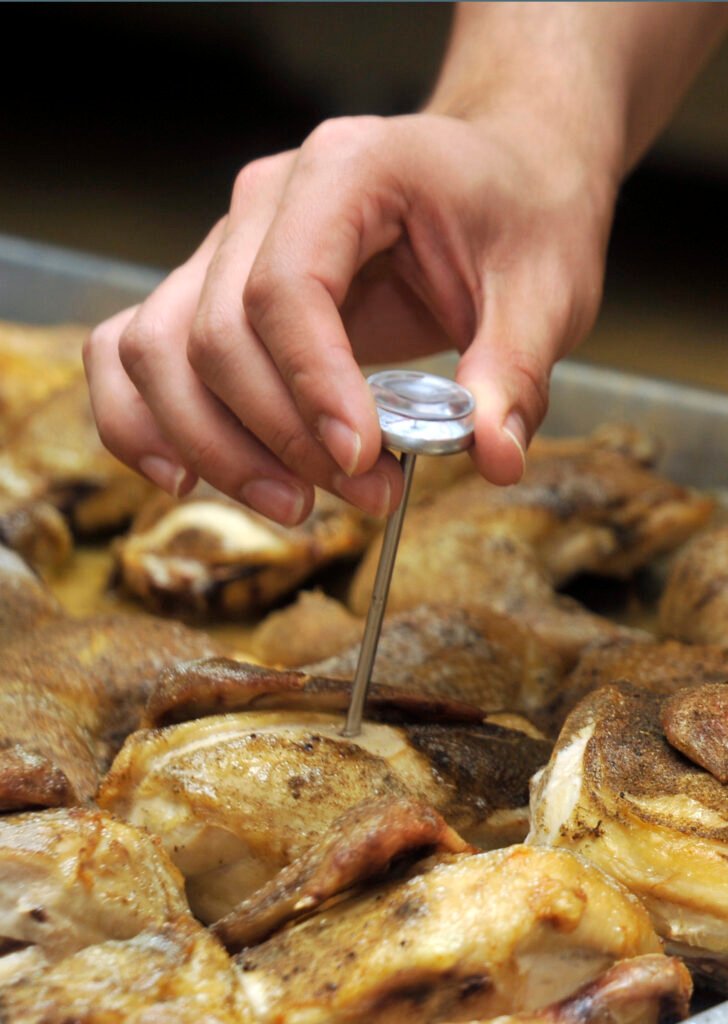
Food can look, smell and taste ordinary even when it contains harmful microorganisms. A household food safety routine therefore needs reliable procedures rather than sensory checks alone. This guide follows the journey of perishable food from the grocery store to the refrigerator, preparation area, cooking appliance and table, and explains how to handle leftovers and recognize serious foodborne illness.
Keep raw animal products separate from ready-to-eat foods, wash hands and preparation surfaces, and use a food thermometer to verify safe cooking temperatures. Under U.S. guidance, refrigerate perishables within two hours, or one hour above 90°F (32°C), and keep the refrigerator at 40°F (4°C) or below. Use food-specific storage limits and discard food when its safety is uncertain.
| Food | U.S. Minimum Temperature |
|---|---|
| Whole Cuts Of Beef, Pork, Lamb And Veal | 145°F / 63°C, Three-Minute Rest |
| Ground Non-Poultry Meat | 160°F / 71°C |
| Poultry | 165°F / 74°C |
| Fish | 145°F / 63°C |
| Egg Dishes | 160°F / 71°C |
| Leftovers | 165°F / 74°C |
Food Safety Begins Before You Cook
A safe meal begins with the condition of its ingredients and the way they are transported. In the grocery store, consider when you will be able to refrigerate or freeze perishable items. Choose refrigerated and frozen products toward the end of a shopping trip when practical. Do not purchase visibly damaged, leaking or otherwise compromised packages simply because they are discounted.
Pack raw meat, poultry and seafood separately from foods that will be eaten without further cooking. A bag of salad vegetables should not share a leaking package of raw chicken. Even when a container appears closed, keep the possibility of leakage in mind. If the outside of a package becomes contaminated, handle it appropriately and clean any affected surfaces.
Plan the journey home. A cooler with suitable ice packs can help keep perishable foods cold during transport, particularly in hot weather or when another stop is unavoidable. A shopping trip followed by several hours in a warm vehicle is a very different situation from a short direct journey to a refrigerator.
Consider what happens when a delivery arrives. Check that perishable food has been delivered under appropriate conditions, follow the seller’s instructions and put it away promptly. Do not leave a bag outside for an extended period merely because the ingredients are still in sealed packaging.
Our food label guide describes how to compare nutrient information. For safety, however, also examine storage instructions, package condition and dates relevant to the product. A favorable nutrient profile cannot make incorrectly stored food safe.
Prevent Contamination During Preparation
Cross-contamination occurs when harmful microorganisms move from one surface, ingredient or object to another. For example, a cutting board used for raw chicken can transfer contamination to vegetables intended to be eaten raw. The vegetables may receive no subsequent cooking step to reduce that risk.
Arrange the preparation area before beginning. If possible, designate separate clean boards and utensils for raw animal foods and ready-to-eat ingredients. If you use the same equipment, wash it appropriately between tasks. Clean the work surface and any handles or other objects touched by contaminated hands. Do not merely wipe visible liquid away with a cloth and assume the area is safe.
Think about the sequence of tasks. A household preparing a cooked protein dish and a salad might assemble the salad first with clean tools, put it aside safely and then handle the raw protein. A different workflow may be appropriate in another kitchen. The important point is to prevent contaminated equipment, hands and ingredients from contacting ready-to-eat food.
Avoid washing raw poultry. Splashing water can spread contamination around the sink and nearby work area; appropriate cooking is the relevant control for pathogens in the poultry. Wash suitable produce under clean running water as directed, but do not wash fruits or vegetables with household detergents or surface disinfectants.
Our beginner meal preparation guide describes ways to organize several meals at once. Food safety should be part of the workflow, especially when several ingredients are prepared simultaneously and cutting boards or utensils are reused.
Make Handwashing And Cleaning Part Of The Workflow
A person can wash their hands at the beginning of preparation and still contaminate them during the next task. Effective hygiene requires attention to transitions. Wash hands before preparing food, after handling raw animal foods, after using the toilet and after other relevant contamination. Use ordinary soap and clean running water and scrub appropriately before rinsing and drying.
Keep the supplies for washing and cleaning accessible. A soap dispenser located behind raw food containers may be inconvenient to operate without touching other surfaces. A well-organized kitchen allows the person preparing food to clean their hands without creating additional contamination.
A kitchen cloth can spread contamination when it is used on several surfaces without appropriate cleaning. Consider how frequently reusable towels, cloths and sponges are changed or cleaned, particularly after contact with raw food. Follow the instructions for cleaning and sanitizing food-contact surfaces. Do not combine household cleaning chemicals or use a surface product on food.
If someone is ill with vomiting or diarrhea, additional precautions may be necessary, including avoiding food preparation for others according to applicable health advice. Gloves do not eliminate this concern and can themselves transfer contamination if used incorrectly.
Our preventive health guide discusses the broader role of practical risk reduction. Hygiene is a food safety control, not a guarantee that an ingredient is free from hazards. Appropriate cooking, cold storage and handling remain necessary even when hands and surfaces have been cleaned.
Understand Safe Internal Cooking Temperatures
The temperature displayed by an oven describes its heating environment, not necessarily the temperature reached at the center of the food. The exterior of a large piece of meat can be browned while the interior remains below the appropriate safety threshold. Color, cooking time and the appearance of juices should not be the sole criteria.
The U.S. government safe temperature chart gives food-specific minimums. Whole cuts of beef, pork, veal and lamb require 145°F (63°C) followed by a three-minute rest; ground beef and similar non-poultry ground meats require 160°F (71°C). Poultry, including ground poultry, and reheated leftovers require 165°F (74°C). Fish is generally cooked to 145°F (63°C), and egg dishes to 160°F (71°C). Consult the full chart for specific foods.
Grinding changes the distribution of possible surface contamination. A whole steak and a ground-meat patty therefore have different cooking requirements. Do not assume that a preference for a particular appearance in one food transfers safely to another.
These figures are U.S. consumer food safety guidance. Other countries may express their advice through different validated time-temperature combinations. Follow the applicable guidance and product instructions, particularly for a specialized method such as low-temperature cooking. Do not improvise lower temperatures based on a recipe’s photograph.
Use an appropriate thermometer to confirm the relevant temperature. If a reading is below the required minimum, continue cooking and verify it again before serving. The equipment and cooking method should support accurate measurement rather than relying on a fixed cooking time regardless of portion size.
Use A Food Thermometer Correctly
A food thermometer measures the temperature of food at the sensor’s location. Some instruments have a narrow sensing tip, while others require a longer section of the probe to be inserted. Read the instructions for the model before selecting a measurement position.
For a thick piece of food, the relevant area is generally the thickest part, avoiding bone and other regions that could produce an unrepresentative reading. Thin foods may require insertion from the side, depending on the design of the thermometer. With larger or irregular foods, check several appropriate locations rather than assuming a single measurement describes the entire item.
A fictional household is roasting several pieces of chicken. The smallest piece reaches the required temperature first, but a larger piece remains cooler. Checking only the smallest piece would not establish that the larger piece is ready. The cook continues to verify the relevant pieces until the minimum temperature has been reached.
Clean the probe before and after use according to the manufacturer’s instructions. Do not transfer a contaminated probe from partly cooked food into ready-to-eat food without appropriate cleaning. A thermometer is a safety tool only when its use does not create another route of contamination.
Our home measurement guide illustrates the importance of consistent technique for a different type of instrument. Food and medical thermometers are not interchangeable; choose the device intended for food temperature measurement. Check calibration and battery condition as instructed, particularly if readings appear inconsistent.
An inexpensive, suitable thermometer used correctly can be more valuable than an elaborate appliance that never verifies the internal temperature. Select equipment based on the actual task, the food and the ability to obtain a dependable reading.
Keep Refrigerated And Frozen Foods At Suitable Temperatures
The refrigerator should maintain a temperature appropriate for perishable food storage. Under U.S. guidance this is 40°F (4°C) or below; the freezer should be at 0°F (-18°C) or colder. An appliance thermometer can help verify the actual conditions. A dial setting or number on a control panel is not always a direct measurement of the temperature throughout the appliance.
Avoid packing the refrigerator so tightly that air circulation is impeded. Store raw meat and poultry in suitable sealed containers that prevent leakage onto foods that will be eaten without further cooking. Keep commonly used ready-to-eat foods in a convenient position without compromising separation.
Do not assume that freezing sterilizes food. It slows or prevents the growth of many microorganisms while food remains frozen, but contamination may remain when the food is thawed. Safe handling and suitable cooking are still necessary.
If a refrigerator loses power or its temperature becomes uncertain, check the applicable food safety guidance before deciding what to retain. The condition of perishable food depends on both time and temperature. Smelling or tasting it is not a reliable method for determining safety. Discard food when its safe storage cannot be established.
The cold food storage chart gives food-specific storage periods. A raw poultry product and a cooked leftover do not necessarily have the same recommended refrigerator life. Preserve the relevant dates and follow any stricter product instructions rather than assigning a universal expiry period to every food.
Cool Leftovers Promptly And Label Them
When cooking several portions, plan how the food will be cooled before the meal begins. Large deep containers can cool more slowly than smaller shallow portions. Divide appropriate leftovers into suitable containers and refrigerate promptly instead of waiting for a large pot to cool completely at room temperature.
U.S. consumer guidance advises refrigerating perishable food within two hours, reduced to one hour when the surrounding temperature is above 90°F (32°C). This limit is particularly important for food served outdoors, left in a warm kitchen or transported after a meal. Time spent at an unsafe temperature is not erased by later refrigeration.
Most cooked meat and poultry leftovers have a recommended refrigerator storage period of three to four days under appropriate conditions. Specific foods may have different limits. Freeze portions that will not be used within the suitable refrigerated period, and label them with the preparation or freezing date.
For an illustrative example, a household prepares six portions on Sunday. Three portions are intended for the following few days, while the others are intended for later in the week. The household promptly chills the food in suitable shallow containers and freezes the later portions rather than keeping the entire batch refrigerated for seven days. The relevant storage guidance still depends on the actual food and conditions.
Our protein nutrition guide explains how protein-containing foods can contribute to meals. A large quantity of prepared protein is useful only when it can be handled and stored safely. Plan portion size and storage capacity together.
Thaw Reheat And Serve Food Without Losing Temperature Control
Safe thawing methods include thawing under refrigeration, using cold water in an appropriate leakproof package with the necessary precautions, or microwave thawing followed by immediate cooking. Follow food-specific guidance. Leaving a large frozen item on the kitchen counter for an extended period can expose its exterior to unsafe temperatures while the center remains frozen.
When reheating leftovers, check that the food reaches the recommended internal temperature. Microwave heating can be uneven, so follow appliance and food instructions about stirring, covering and standing time where appropriate. Test several locations if needed. Reheating does not reliably make food safe after improper storage; some hazards may persist even when microorganisms are killed.
Consider serving arrangements. If a meal will remain available for several hours, maintain suitable hot or cold holding conditions rather than assuming the food remains safe because it was initially cooked correctly. A small serving dish replenished appropriately may be more practical than displaying all the perishable food at once.
A fictional family packs a cooked lunch for a long journey. They consider whether it will be eaten soon, kept properly chilled or held hot using suitable equipment. If none of these arrangements is practical, they choose a shelf-stable alternative rather than relying on the appearance of the meal later.
The four-step food safety guide explains the importance of separating foods, cooking safely and controlling storage temperature. The same principles apply when a prepared meal leaves the kitchen. A safe recipe is only one part of safe food handling.
Recognize Foodborne Illness And Higher-Risk Situations
Foodborne illness can cause nausea, vomiting, diarrhea, fever or abdominal discomfort. Different infections and toxins can produce symptoms at different intervals, so the most recent meal is not necessarily responsible. A clinician may consider symptoms, exposure history and appropriate tests.
The CDC food poisoning guidance identifies serious features such as bloody diarrhea, prolonged diarrhea, high fever, inability to retain fluids and signs of dehydration. Seek medical advice promptly for these symptoms. Severe confusion, collapse, significant breathing difficulty or other emergency symptoms require immediate care.
Pregnant people, young children, older adults and people with weakened immune systems can be at greater risk from particular foodborne illnesses. The government food safety resource for higher-risk groups describes additional considerations. Follow specific professional and public health guidance rather than relying on general household practices alone.
Our hydration guide discusses general fluid needs, but a person who is losing substantial fluid through vomiting or diarrhea may need medical advice about replacement. Do not rely on generic daily water recommendations to manage serious illness.
If several people become ill after a shared event, retain relevant details about what they ate, where the food came from and when symptoms began. Contact the appropriate healthcare or public health service when indicated. Do not serve suspected food to another person to see whether it is safe. Prevention and timely assessment are more important than trying to identify a cause independently.
Frequently Asked Questions
Can I tell whether leftovers are safe by smelling them?
Appearance and smell cannot reliably exclude dangerous contamination.
What temperature should chicken reach?
U.S. guidance specifies 165°F (74°C) for poultry.
Can I leave food on the counter until completely cold?
Refrigerate perishables promptly; shallow containers help appropriate cooling.
Should I wash raw chicken?
Avoid washing raw poultry because splashes can spread contamination.
How long can cooked leftovers stay refrigerated?
Many cooked leftovers have a three-to-four-day limit under suitable conditions; consult food-specific guidance.
Can reheating fix improper storage?
It does not reliably make improperly stored food safe.
When should I seek care for food poisoning?
Seek medical advice for severe or prolonged symptoms, bloody diarrhea, high fever, frequent vomiting or dehydration; emergencies require immediate help.
- FoodSafety.gov: Four Steps
- FoodSafety.gov: Safe Internal Temperatures
- FoodSafety.gov: Cold Storage Chart
- CDC: Food Poisoning Symptoms
- FoodSafety.gov: Higher-Risk Groups
Featured image: U.S. Air Force / Zachary Kee, Food Thermometer 2, U.S. public domain; resized or cropped for display.

General household food safety education, not a medical diagnosis or commercial food safety protocol.
Discover more from The Secret
Subscribe to get the latest posts sent to your email.