
Grip strength affects many ordinary tasks, from holding a shopping bag to operating a household tool. It is also measured in some clinical and research settings as an indicator of physical function. These uses are related but not identical. This guide explains the different kinds of grip, how measurements are obtained, how to interpret their limitations and how to introduce manageable hand and forearm strengthening when appropriate.
Grip strength describes the force that can be produced when grasping an object. A hand dynamometer can measure a specific type of grip under standardized conditions. For healthy adults, gradual resistance exercise and suitable gripping tasks can help develop grip capacity. Pain, numbness, sudden weakness or an existing hand injury requires appropriate assessment rather than repeated maximal squeezing.
| Task | What To Consider |
|---|---|
| Brief power grip | Force, handle fit and control |
| Pinch grip | Thumb and finger coordination |
| Sustained grip | Endurance and comfort |
| Dynamometer test | Specific standardized measurement protocol |
Understand The Different Demands Of Gripping
The hand is capable of several kinds of grasp. A person holding the handle of a shopping bag uses a different arrangement of fingers and thumb from someone turning a key. Holding an object for a prolonged period also differs from producing a brief high force. Describing all of these tasks with one grip strength number can obscure the particular skill or physical capacity required.
A power grip involves the fingers wrapping around an object with support from the palm. A pinch involves opposing the thumb and one or more fingers. A sustained grasp may require a different combination of muscular endurance, coordination and comfort. The muscles and tendons of the hand and forearm work together, and the position of the wrist can influence performance.
In everyday life, the goal is often to perform a particular task comfortably rather than maximize force. A person who has difficulty opening a container may benefit from a different handle or an assistive tool as well as appropriate strengthening. Someone who cannot safely hold a heavy object does not need to prove their strength by repeatedly lifting it.
Our beginner strength training guide discusses the role of movement selection and manageable resistance. Grip practice can be included in a suitable resistance routine, but not every exercise needs to create substantial hand fatigue. The best starting point is the actual function the person wants to improve.
Understand What A Dynamometer Measures
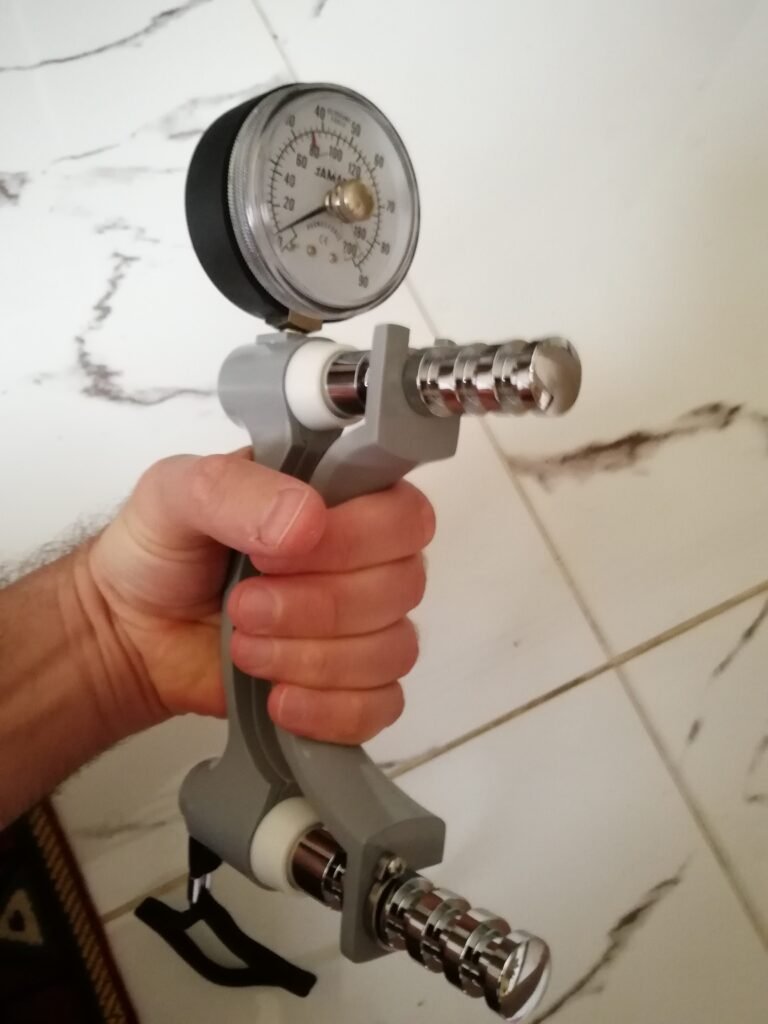
A hand dynamometer is a device designed to measure force produced during a particular grip task. Depending on its construction, it can use a hydraulic mechanism, a spring or an electronic sensor. Its reading describes performance under the conditions of the test. It does not measure every aspect of hand function, dexterity or endurance.
Measurement methods differ across research, clinical practice and fitness settings. The handle spacing, body position, wrist angle, instructions, number of attempts and rest between attempts can all influence the result. A review of handgrip measurement methods discusses the importance of these methodological factors. It is therefore misleading to compare arbitrary readings without knowing how they were obtained.
The display may report kilograms-force, pounds-force or newtons. A reading on a force-measuring instrument is not identical to the mass of a dumbbell that a person can hold. Keep the unit specified by the device and the exact model when recording a measurement.
A dynamometer is not the same as a hand gripper intended for resistance exercise. A gripper’s advertised resistance may describe its spring or mechanism under particular conditions rather than a measurement of the user’s actual force. A person who can close a particular gripper cannot automatically assign that product’s stated number to a clinical grip strength test.
Before purchasing a measurement device, decide whether the reading would help answer a relevant question. A clinical assessment may be more useful than home testing when symptoms or a significant functional limitation are present.
Interpret Research Reference Values Carefully
Grip strength is used in some medical and research assessments because it can provide information about muscle function. It may be considered alongside other measures when evaluating conditions such as age-related loss of muscle strength. However, a home grip reading alone cannot diagnose a particular condition or predict an individual’s health outcome.
An international systematic review of adult handgrip strength norms compiled data from large populations and described variation in testing methods. Reference distributions can help researchers and clinicians understand typical results within defined groups. They are not universal targets that every person should try to reach.
Age, body size, hand dimensions, prior training, pain and other factors may influence a person’s performance. The dominant and nondominant hands can also differ. A difference between hands is not automatically evidence of disease, although a new or unexplained change may require appropriate assessment.
Consider a fictional person who compares a reading from a spring device at home with a published value measured using a hydraulic device under a supervised protocol. Even if the units appear to match, the measurements may not be directly comparable. The equipment and procedures matter.
Our fitness tracker guide explains a related principle: a numerical result is only as useful as the measurement context permits. Do not use an online grip chart to conclude that you have a medical disorder or that your overall health is satisfactory. Ask an appropriate professional to interpret measurements when a clinical question is involved.
Choose A Suitable Measurement Or Training Device
If your goal is recording grip force, look for a device that provides clear information about its intended use, measurement range, units and operating instructions. Check whether the handle adjusts to the intended user’s hand size. A device that cannot be held comfortably may produce a result that reflects awkward positioning rather than the person’s actual capacity.
Consider the evidence available for the specific model. A research comparison of different grip strength measurement devices illustrates why equipment selection can influence assessment. The number of decimal places on a display does not establish that the instrument is accurate enough for a clinical purpose.
For general strengthening, a purpose-designed adjustable gripper, a suitable soft exercise ball or other appropriate resistance equipment may be sufficient. These options provide different movement experiences. A soft object may allow gentle repeated gripping, while a spring gripper can create greater resistance. Neither is automatically suitable for a painful or injured hand.
Check construction, fit, cleaning requirements and the manufacturer’s recommended use. Avoid products with damaged springs, sharp edges or components that can unexpectedly move. Do not select an unusually demanding gripper merely because its packaging promises rapid strength improvement.
Our resistance equipment comparison discusses how equipment should fit the intended task. The same applies to grip tools. If an ordinary full-body routine already challenges the hands sufficiently, a separate specialized purchase may not be necessary.
Record Comparable Measurements Without Overdoing Testing
If a healthcare professional has recommended grip testing, follow the method they specify. Clinical protocols may define the device, handle setting, position, instructions, repetitions and reporting method. Do not substitute a different test and assume it provides an interchangeable result.
For a healthy adult choosing to monitor general training progress, consistency is more useful than frequent maximal testing. Record the device and handle setting, the hand tested, position and the measurement unit. If a particular protocol requires several attempts, follow the instructions about rest and whether the highest or average value is recorded.
A fictional training record might contain readings collected using the same device and configuration on two different dates. The person notes that the second measurement was taken immediately after a demanding lifting session. Because fatigue could affect the result, they do not treat that reading as direct evidence that grip strength has declined.
Avoid repeated squeezing to obtain a preferred score. A measurement intended to describe force should not become a demanding additional workout every day. Do not attempt maximal testing when pain, recent injury, medical restrictions or other relevant concerns are present. If measurement produces unusual symptoms, stop.
Our sets and repetitions guide explains the distinction between training workload and performance measurement. A useful record supports decisions about a manageable program rather than creating a requirement to improve at every test.
Begin With Manageable Gripping Practice
For an otherwise healthy adult, introductory grip practice can be simple. Choose a suitable soft resistance object or a manageable hand gripper. In a comfortable supported position, close the hand gently around the object and then release it under control. The movement should remain comfortable, and the person should be able to relax the hand between repetitions.
An illustrative starting session might consist of a small number of gentle repetitions, such as five to eight, followed by rest. If that is manageable, a second short set could be appropriate. This example is not a validated rehabilitation program or a requirement to reach a particular repetition target. The selected resistance and the person’s condition determine the actual demand.
A person who finds sustained gripping uncomfortable can choose brief controlled repetitions instead. Someone whose difficulty involves pinching or fine motor tasks may need a different approach. A hand therapist or other qualified professional can recommend appropriate exercises when an injury, surgery or functional impairment is involved.
The University Hospitals Sussex hand movement resource describes movements used in hand care. Such clinical resources are intended to support the circumstances for which they were provided. Do not copy a treatment schedule intended for another patient without considering its suitability.
Our gradual progression guide explains how a person can modify a training demand one step at a time. Increasing gripper resistance, set duration and repetition count simultaneously may create an unnecessarily large change in workload.
Include Grip In A Broader Strength Routine
Many ordinary resistance exercises already require some gripping. A suitable dumbbell row, for example, involves holding the dumbbell while performing the intended movement. A person may develop grip capacity through such tasks without completing a separate long hand workout. The grip demand should remain appropriate for the exercise and the user’s ability to control the equipment.
When selecting resistance, consider the ability to pick up and put down the equipment safely as well as perform the movement itself. A person may have sufficient strength to carry out a particular exercise but struggle to manage the handle when tired. Reduce resistance or choose a suitable alternative if equipment handling becomes unreliable.
Our dumbbell comparison explains how handle dimensions and equipment design can affect practical use. An uncomfortable or poorly fitting handle is not necessarily a better training stimulus. Select equipment that supports controlled performance.
If grip strengthening is a separate priority, place the additional work where it does not compromise other important exercises. For example, a fictional adult who performs a regular pulling exercise may complete a brief manageable grip practice afterward rather than exhausting the hands beforehand. If the person’s main goal is a supervised assessment of grip, the appropriate arrangement could differ.
Our training order guide discusses how fatigue from one activity can influence another. The same reasoning applies within resistance training. Prioritize the work that requires the greatest attention and keep the total workload appropriate.
Manage Recovery And Recognize Hand Symptoms
The hand and forearm can become fatigued after repetitive gripping, particularly when the activity is unfamiliar. However, discomfort is not a requirement for strength improvement. Persistent pain, swelling, numbness, tingling or a change in hand function should not be treated as proof that the exercise is effective.
Stop an activity that produces acute or worsening pain or neurological symptoms. Seek medical advice when symptoms persist, recur or interfere with ordinary tasks. Sudden weakness, particularly if it occurs with facial weakness, speech difficulty or other possible stroke symptoms, requires emergency assessment. A grip measurement cannot establish the cause of sudden weakness.
A person who recently injured a finger, wrist or hand should follow injury-specific instructions rather than using a generic exercise gripper. Our sprain and strain first aid guide explains why acute injuries need appropriate protection and assessment. Loading that is suitable for an uninjured adult may be inappropriate during particular stages of healing.
Consider other demands on the hands throughout the day. Work involving tools, repeated gripping or prolonged typing may contribute to fatigue. A training plan that looks modest in isolation may be excessive when added to substantial occupational demands.
Our recovery guide describes the value of allowing sufficient recovery between exercise sessions. If grip work interferes with ordinary tasks or the next strength session, reduce its difficulty or frequency. Additional recovery products cannot compensate for an unsuitable workload.
Make Everyday Function The Main Measure Of Progress
A useful progress review starts with the purpose of the training. If the goal is to hold a familiar object more comfortably, assess that task under safe conditions rather than relying solely on a maximal grip score. A person who wants to use household tools more easily may also benefit from improved handle design or an assistive device.
Consider a fictional adult who finds a light shopping bag tiring. They begin with a manageable general strengthening routine and choose easier ways to carry purchases while building capacity. They notice whether ordinary tasks become more comfortable over time. They do not increase the bag weight merely to demonstrate progress or force the grip to continue when it becomes painful.
A simple training log may contain the exercise used, approximate resistance, repetitions, comfort and relevant changes in everyday function. If a measurement device is used, compare readings under similar conditions and avoid interpreting every small change as a meaningful improvement or decline.
Our weekly physical activity guide explains why general strengthening is only one component of an appropriate activity pattern. Grip practice should support the broader routine rather than displace other suitable activities or necessary rest.
If a person continues to struggle with essential hand tasks despite reasonable adjustments, an occupational therapist, hand therapist or other qualified healthcare professional may be able to investigate the limitation and recommend suitable strategies. The aim is practical function and safe participation, not matching a particular number from a chart.
Frequently Asked Questions
What does a grip dynamometer measure?
It measures force during a specific grasping task according to the device and test method.
Can I diagnose weakness from a home grip score?
Clinical interpretation depends on the protocol, reference population and other findings. A home score alone cannot establish a diagnosis.
Do I need a gripper to develop grip strength?
Suitable ordinary resistance exercises may already challenge grip. A separate tool is optional.
Should I test my maximum every day?
Frequent maximal testing is unnecessary for general training and may add fatigue. Follow a relevant professional protocol if testing is prescribed.
Why do readings differ between devices?
Device construction, calibration, handle spacing and test methods may influence results.
Should grip exercises hurt?
Stop for acute or worsening pain, numbness or concerning symptoms, and obtain appropriate advice.
Can grip training help with daily tasks?
Suitable practice may support particular tasks, but coordination, comfort, equipment design and medical factors also matter.
- Handgrip Strength In Health Applications: Measurement Review
- International Norms For Adult Handgrip Strength
- Grip Measurement Device Variation Study
- University Hospitals Sussex: Range Of Movement Hand Exercises
Featured image: Ashashyou, Hand Dynamometer, CC0 1.0; resized or cropped for display.

General fitness education, not individualized hand rehabilitation or diagnosis.
Discover more from The Secret
Subscribe to get the latest posts sent to your email.