
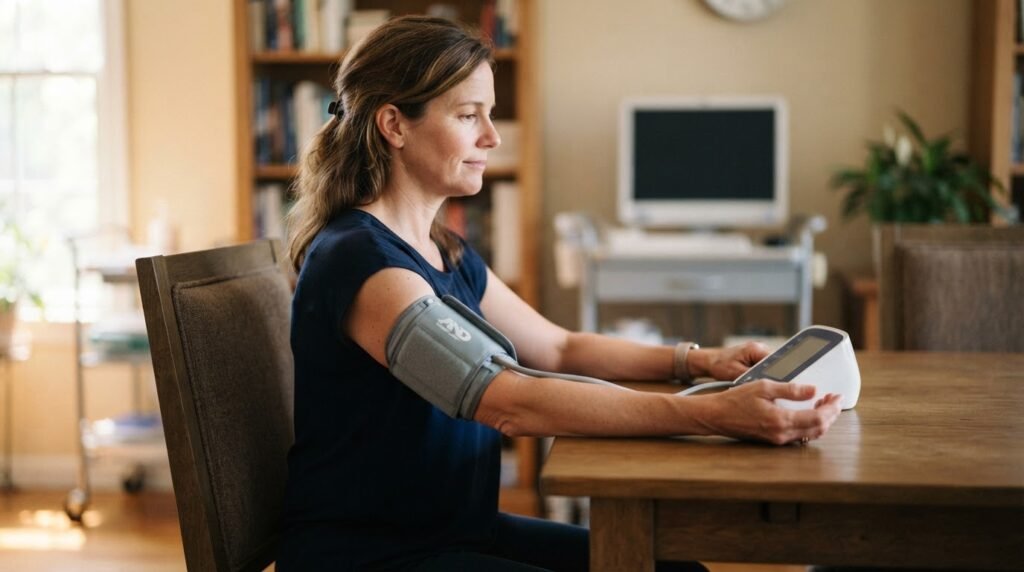
Home blood pressure monitoring can give your healthcare team useful information that a single clinic reading cannot provide. However, the value of the record depends on how the measurements are made. A reliable device used in an inconsistent position may still produce misleading results. This guide explains how adults can prepare, measure, record and share readings safely.
Use a validated automatic upper-arm monitor with a suitable cuff. Prepare in advance, rest quietly for at least five minutes, sit with your back and arm supported and take two readings about one minute apart. Record both. Follow your clinician’s monitoring plan and never change prescribed treatment based only on a home reading. Emergency symptoms require immediate care.
Understand What Home Monitoring Can And Cannot Tell You
Blood pressure describes the force exerted by circulating blood against the walls of arteries. The systolic number reflects pressure during the heart’s contraction, while the diastolic number reflects pressure between beats. These measurements are expressed in millimeters of mercury. They are not the same thing as heart rate, even though many automatic devices display a pulse value alongside them.
Pressure changes naturally during the day in response to activity, posture, stress and other factors. A clinic reading and a home reading may therefore differ even when both were obtained correctly. A standardized record helps a clinician examine patterns across repeated observations. It may be useful in investigating a suspected blood pressure problem, following a treatment change or reviewing a person’s ongoing management.
A home monitor does not independently diagnose hypertension or establish that a medicine is no longer needed. A healthcare professional considers the record alongside medical history, other examinations and appropriate diagnostic criteria. Some people need ambulatory monitoring, which measures pressure at intervals over a longer period including during ordinary activities and sleep. That is different from a home record made at selected times.
If you are not sure whether monitoring is suitable or how frequently you should do it, raise the question during a routine medical visit. A specific clinical purpose prevents unnecessary measurements and helps you understand what the results will be used for.
Select And Check Your Monitor Before Starting
For routine adult home monitoring, the American Heart Association favors an automatic upper-arm cuff monitor that has been validated. Validation refers to evidence that the particular device model meets an appropriate accuracy standard. A manufacturer’s general advertising claim or the appearance of a familiar brand does not establish that every model has been evaluated.
Measure the circumference of the upper arm according to the manufacturer’s guidance and check the range printed for the cuff. A cuff designed for a much smaller or larger arm can introduce measurement error. Avoid assuming that a cuff labeled standard will fit everyone. For people with a large or unusually shaped arm, a healthcare professional can help identify a suitable option.
Our home blood pressure monitor buying guide explains validation, cuff selection and practical device features. Bring your own monitor and cuff to an appointment so the healthcare team can check the equipment and observe your measurement technique. A trained professional may also recommend a different device for someone with a particular medical condition.
Before beginning a monitoring period, check the batteries or approved power supply, date and time settings, display readability and user memory settings. If several people share the monitor, use separate profiles where available. Otherwise, a record that mixes readings from different individuals may be difficult or impossible to interpret correctly.
Prepare A Consistent Measurement Area
Choose a quiet place where you can sit without interruption. A supportive chair and a table are usually sufficient. The table should allow the measurement arm to rest at approximately heart level; a firm cushion may help achieve this position. Avoid sitting on the edge of a soft sofa where the back and feet are unsupported.
Keep the monitor close enough that you do not have to lean forward to operate it. Arrange the tubing as instructed by the manufacturer so it is not bent or trapped. If the display is difficult to read, consider accessibility features or assistance from a trusted person who understands the procedure. The environment should make accurate positioning easier rather than demanding sustained effort to maintain it.
Prepare the log or device memory before resting. Answering messages, searching for a pen or moving furniture immediately before a reading can interfere with the quiet preparation period. Ask household members not to interrupt while the monitor is operating.
A dedicated measurement area is not a requirement. When traveling, recreate the relevant conditions as closely as possible. Note significant departures from the normal routine instead of treating measurements obtained in different circumstances as perfectly comparable. Consistency matters more than the appearance of the room.
Prepare Your Body For The Reading
Follow the instructions given by your healthcare team. For a routine standardized measurement, avoid caffeine, tobacco use and exercise during the preceding half hour. Use the bathroom if necessary before sitting. Plan around meals as your clinician recommends; CDC guidance also advises avoiding food and drinks for the half hour before a reading. Do not delay essential medications or meals when doing so would conflict with your medical plan.
Sit quietly for at least five minutes. Allow the body to settle after walking into the room or climbing stairs. The purpose is to measure under a consistent resting condition rather than to find the lowest reading you can possibly obtain. Do not use an elaborate relaxation exercise to manipulate the measurement or repeatedly start over until a preferred number appears.
Wear clothing that permits access to the upper arm without a tight rolled sleeve pressing on it. Apply the cuff directly to the skin. If your schedule requires measuring before leaving for work, allow enough time to sit rather than measuring while standing near the door.
The CDC measurement guide explains how everyday circumstances and posture can affect readings. These are standardization steps, not a reason to postpone emergency assessment when serious symptoms occur.
Position Your Body And Cuff Correctly
Sit with the back supported and both feet resting on the floor or an appropriate support. Keep the legs uncrossed. Rest the selected arm on the table with the shoulder relaxed and the cuff near heart height. Do not hold the arm up by muscular effort. If the table is too low, a stable support can help place the arm at the correct height.
Wrap the cuff according to the manufacturer’s illustration. Its lower edge is generally positioned just above the elbow bend, and the alignment marker should follow the device instructions. The cuff should be snug rather than hanging loosely. Do not place it over clothing, and do not improvise a cuff that is incompatible with the machine.
Ask your healthcare professional which arm to use consistently, especially if there is a known difference between arms or a medical reason to avoid one arm. Someone who has had certain surgeries, has a dialysis access or has other arm-specific restrictions needs advice before applying a cuff. Forcing a standard procedure onto a person with special requirements may be inappropriate.
During measurement, keep still and avoid conversation. Rest the hand comfortably rather than clenching it. If another person assists, they should also avoid discussing the reading while it is being obtained. A short period of quiet makes the procedure more reproducible.
Take Two Readings And Preserve Both Results
Once you have rested and positioned the cuff, operate the monitor according to its instructions. Allow the cuff to inflate and deflate without moving your arm or adjusting your posture. Write down the displayed systolic and diastolic values, or verify that they have been saved in the correct device profile.
Wait about one minute before taking the second reading, staying seated and relaxed. A small difference between readings is common. Preserve both results rather than deleting the higher value or retaining only the number that looks closest to a target. Your clinician can specify whether additional readings are useful and how they should be summarized.
For an illustrative example, imagine a first reading of 128/78 and a second reading of 124/76 mm Hg. The arithmetic mean is 126/77 mm Hg. The example shows how two separate numbers are averaged; it is not a medical interpretation of those values and should not be used to determine an individual’s treatment.
If the device displays an error, consult its instructions, check the cuff and posture and note repeated problems. Automatic monitors can sometimes have difficulty obtaining a reading in the presence of movement or certain irregular heart rhythms. Repeated error messages are a reason to ask for help, not to guess what the missing value might have been.
Keep A Log That Is Useful To A Clinician
A practical record includes the date, time, both systolic and diastolic results, the arm used and any relevant note. A person who is following a treatment plan can ask whether the clinician also wants pulse measurements, medication timing or symptom information. Avoid cluttering the record with irrelevant details that make the key information difficult to find.
For instance, a fictional monitoring entry might show a morning measurement at 7:30, two readings, the right arm and a note that the usual preparation steps were followed. An evening entry might document that the person had recently been physically active and waited before measuring. If the circumstances differed materially from the agreed protocol, note the deviation honestly.
Do not erase an unexpectedly high reading merely because the following reading was lower. Similarly, do not repeatedly measure until you find a high value. Follow the agreed schedule and preserve information that may be clinically relevant. A home record is evidence for a professional conversation rather than a competition.
A notebook is sufficient for many households. A spreadsheet or an app may be helpful when records are lengthy, provided the user can export them and control who has access. Avoid sending medical information to unfamiliar services. Our wearable selection guide discusses related privacy and measurement issues, although a fitness wearable is not a substitute for a validated cuff monitor.
Know When A Reading Needs Urgent Attention
Ask your healthcare team what action to take for readings outside the expected range and what symptoms require emergency care. The American Heart Association’s adult guidance identifies a systolic pressure above 180 or a diastolic pressure above 120 mm Hg as a severe range. If a reading in this range occurs without emergency symptoms, wait at least one minute, repeat the measurement and contact a healthcare professional immediately if the result remains very high.
If you have a severely elevated reading together with symptoms such as chest pain, breathing difficulty, new weakness or numbness, changes in vision, difficulty speaking or other signs of a medical emergency, call emergency services immediately. In the United States that is 911; elsewhere use the applicable local number. Do not wait for the reading to fall spontaneously. Symptoms of a heart attack or stroke warrant emergency assessment even if you cannot obtain a blood pressure reading.
Pregnancy and the postpartum period require separate clinical protocols. Do not use the general adult severe-range threshold as a rule for deciding whether to obtain maternity care. Follow the maternity team’s instructions for abnormal readings or concerning symptoms.
For readings that are lower than expected or accompanied by dizziness, faintness or other symptoms, contact an appropriate healthcare professional and seek emergency assistance when symptoms are severe. Do not independently stop, increase or skip prescribed medication. The American Heart Association home monitoring resource explains the role of the healthcare team and the emergency response.
Avoid Common Errors And Misleading Comparisons
A cuff that does not fit, crossed legs, an unsupported arm, talking and a rushed preparation period are common practical problems. Each may change the result. If the circumstances are different from one measurement to the next, it becomes more difficult to distinguish a change in blood pressure from a change in technique.
Another error is comparing an immediate post-exercise reading with a standardized resting reading without recognizing the difference in conditions. Exercise monitoring may have a legitimate clinical purpose, but it requires a separate protocol. Our cardio intensity guide is intended for general fitness education, not for diagnosing blood pressure responses to exercise.
Do not treat wrist wearables, phone applications or unvalidated cuffless estimates as interchangeable with a clinically appropriate monitor. Even if a device provides a numeric result, the method and evidence matter. A monitor’s convenience is useful only if the resulting measurements are appropriate for the intended purpose.
If records are consistently different from clinic measurements, bring the equipment and log to the healthcare team. They can review technique, investigate the difference and determine whether another measurement method is needed. A disagreement is information to evaluate rather than proof that one setting always gives the true value.
Use The Record To Improve Your Next Appointment
Before the appointment, organize your readings in chronological order and bring the monitor if requested. Write down questions about the monitoring schedule, treatment targets, unusual readings and symptoms. Ask what should be done if the monitor is unavailable for a day or repeatedly produces errors.
The appropriate threshold for diagnosis or treatment is not necessarily identical across countries, age groups, medical conditions and measurement settings. Home measurement is a clinical tool that works best when its results are interpreted in context. Our preventive screening guide explains why risk and follow-up are important when deciding what medical checks are useful.
A successful routine produces a clear and honest record, respects the person’s medical plan and does not take over the whole day. Once your clinician has enough information to make the intended decision, ask whether the schedule should change. Monitoring more frequently is not automatically more beneficial.
Frequently Asked Questions
Which arm should I use?
Ask your healthcare professional which arm is appropriate for consistent readings and whether any arm-specific restrictions apply.
Can I measure through a sleeve?
Use the cuff on bare skin according to the device instructions.
Why are my two readings different?
Blood pressure varies naturally, and small differences are common. Record both results.
Should I measure immediately after exercise?
Not for a routine resting measurement. Allow the recommended preparation interval unless your clinician has specified another protocol.
Can I stop medication when readings improve?
No, continue prescribed treatment unless your healthcare professional changes it.
Does my smartwatch replace a cuff?
Do not assume a wearable is suitable for clinical monitoring. Use equipment recommended for your medical purpose.
Is one high reading a diagnosis?
A clinician interprets repeated readings and other relevant evidence. Seek immediate care for emergency symptoms or severe readings as directed.
- American Heart Association: Home Blood Pressure Monitoring
- CDC: Measuring Your Blood Pressure
- AHA Scientific Statement: Measurement Of Blood Pressure In Humans
General educational information, not individualized medical guidance. Featured image is illustrative and does not replace the device’s instructions.
Discover more from The Secret
Subscribe to get the latest posts sent to your email.