
A choking emergency can develop quickly during a meal or another activity. Recognizing the difference between an effective cough and severe airway obstruction helps a bystander take the appropriate action. This guide follows the current adult foreign-body airway obstruction principles described by the American Heart Association and American Red Cross. It is intended for education and should complement recognized practical first aid training.
If an adult is coughing effectively, encourage coughing and closely observe them. If they cannot speak, breathe normally or cough effectively, activate emergency services and give up to five firm back blows followed, if needed, by five abdominal thrusts. Repeat until the obstruction clears or the person becomes unresponsive. Use chest thrusts instead of abdominal thrusts in pregnancy or when you cannot encircle the abdomen. If unresponsive, begin CPR with chest compressions, follow dispatcher guidance and remove only an object you can see.
| Adult’s Condition | Immediate Priority |
|---|---|
| Effective cough | Encourage coughing and observe |
| Responsive, severe obstruction | Activate emergency services; up to five back blows, then five abdominal thrusts if needed |
| Pregnancy or abdomen cannot be encircled | Use chest thrusts instead of abdominal thrusts, alternating with back blows |
| Becomes unresponsive | Begin CPR with compressions; follow dispatcher instructions |
Recognize The Difference Between Effective Coughing And Severe Choking
The airway is the route through which air travels into and out of the lungs. When a foreign object interferes with that route, the person’s ability to cough, speak and breathe may be affected. The severity can change as the object moves or the person becomes fatigued. A bystander should pay attention to what the person can actually do rather than relying on a single gesture.
Someone with an effective cough may still be able to make a strong sound and move air. Encourage them to continue coughing and observe closely. Do not leave them alone or give thrusts simply because they are coughing during a meal. If the cough becomes weak or ineffective, their ability to speak disappears or breathing becomes severely impaired, the situation requires immediate emergency action.
Severe obstruction may produce little or no sound despite an obvious attempt to breathe. A person may grasp their throat, appear distressed or develop changes in skin color. These signs are useful, but the absence of a particular sign does not rule out choking. Do not wait for bluish discoloration before acting when the person clearly cannot breathe adequately.
Other medical emergencies can also cause breathing difficulty. An allergic reaction, for example, can involve swelling rather than a food particle blocking the airway. Obtain emergency help if you are uncertain about the cause of severe breathing difficulty. Our first aid preparedness guide explains why emergency contact details and appropriate training are valuable. The ability to recognize and communicate the problem is as important as having supplies available.
Activate Emergency Help Without Delaying Immediate Care
Check that the scene is safe for you and the person. If they are responsive and the circumstances allow, communicate briefly and obtain consent. A simple question asking whether the person is choking can help establish what is happening. When they cannot speak or cough effectively, do not require a lengthy verbal confirmation before taking emergency action.
Arrange for the local emergency medical service to be called promptly. If others are present, give one person the specific task of making the call and another, where appropriate, the task of obtaining an automated external defibrillator, or AED. If you are alone with the person, follow local emergency calling and dispatcher guidance while providing appropriate care. A speakerphone can help when it is available and safe to use.
Tell the dispatcher your location, that an adult appears to have a severe airway obstruction, whether the person is responsive and what assistance is underway. Follow the dispatcher’s instructions. Do not delay the call because you want to try several interventions first. Severe choking can deteriorate rapidly.
Our wound first aid guide describes another situation in which arranging emergency assistance and providing immediate appropriate care can occur together. The particular treatment differs, but the principle of avoiding unnecessary delay remains relevant.
Avoid moving the person to a distant location simply for privacy if doing so delays care or creates additional danger. Clear nearby obstacles, make space for the responder and help emergency personnel locate you. The immediate goal is to restore adequate airflow and obtain professional support, not to establish exactly what the object is.
Give Back Blows As The Initial Physical Intervention
The 2025 American Heart Association adult basic life support guidance recommends starting with back blows for a responsive adult with severe foreign-body airway obstruction. The American Red Cross uses a similar sequence. Begin physical interventions only when the person’s cough is ineffective or other signs indicate severe obstruction, not simply because an adult is coughing forcefully.
Stand beside and slightly behind the person, using a position that allows you to support them. Support the chest with one arm and help them bend forward. With the heel of your other hand, give a firm blow between the shoulder blades. Deliver separate blows, up to five, reassessing whether the obstruction has cleared.
Stop the series if effective breathing, coughing or speaking returns. The number five is the maximum in that part of the sequence, not an instruction to continue striking someone after the object has been expelled. If the airway remains severely obstructed after the back blows, move to the appropriate thrusts.
The AHA adult basic life support guidelines describe this approach. Learn hand placement, body positioning and the transition between steps through a recognized practical course. Do not practise forceful blows on a healthy person.
A bystander may remember older advice that emphasized abdominal thrusts first. Current guidance matters because first aid recommendations can change as evidence is reviewed. Using the updated sequence helps avoid confusion when different responders arrive. If an emergency dispatcher gives specific instructions, follow them rather than pausing to consult multiple articles.
Give Abdominal Thrusts When Appropriate
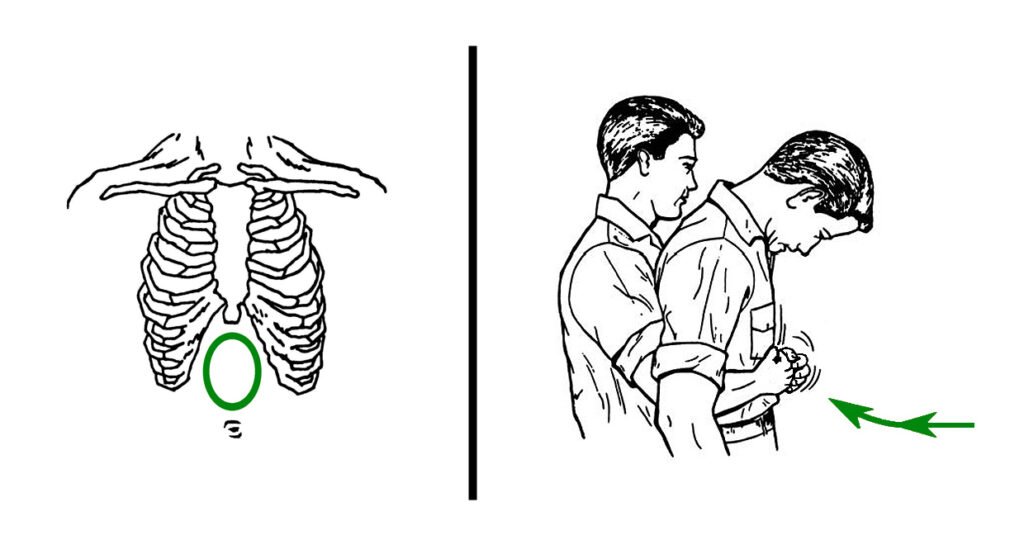
If up to five back blows do not relieve severe obstruction in a responsive adult, move behind the person and establish a stable stance. Make a fist and place the thumb side against the abdomen above the navel and below the breastbone. Grasp your fist with the other hand. Deliver a separate, quick inward and upward thrust, repeating as needed up to five times.
If the obstruction remains, return to back blows and alternate the two interventions in cycles of up to five each. Stop if the person regains effective breathing, coughing or speech, or transition to the appropriate unresponsive-person response if they lose responsiveness. Do not continue abdominal thrusts when the obstruction is no longer present.
Placement matters. Avoid directing abdominal thrusts into the lower ribs or the tip of the breastbone. Use the appropriate technique learned during first aid training and follow emergency dispatcher instructions. Abdominal thrusts can cause injury, which is one reason they are reserved for severe obstruction rather than an effective cough.
The American Red Cross adult choking resource provides practical educational guidance and training options. Recognize that an illustration of hand placement is not a complete demonstration of body support, reassessment and the transition between steps.
Our first aid kit guide encourages appropriate training as part of household preparation. Adult choking care does not usually depend on finding a special device before beginning these actions. Prompt recognition, emergency activation and correctly performed first aid are the immediate priorities.
Adapt Thrusts For Pregnancy And Accessibility
Abdominal thrusts are not appropriate in every circumstance. The American Heart Association recommends alternating back blows with chest thrusts for adults in the late stages of pregnancy and when the rescuer cannot encircle the person’s abdomen. The American Red Cross also directs responders to use chest thrusts for an obviously or known pregnant person. Follow dispatcher instructions and the recognized training relevant to your location.
For chest thrusts on a responsive adult, use the appropriate central breastbone hand placement and backward-directed thrust technique, avoiding the lower tip of the breastbone and ribs. This is not the same procedure as chest compressions performed during CPR on an unresponsive person. Practical instruction is particularly useful for learning the difference.
A person who uses a wheelchair may have a different accessible position. The responder may need to adapt their stance and choose chest thrusts when abdominal thrusts cannot be performed safely. Follow dispatcher guidance. Avoid unnecessary transfers or actions that create additional risk for the person or responder.
Our exercise guide illustrates the broader importance of considering individual capacity and circumstances rather than assuming one physical position is suitable for everyone. During a first aid emergency, adapting an established technique requires even greater care.
If you support someone with a swallowing difficulty or a disability affecting emergency response, ask an appropriate clinician and recognized first aid trainer about preparation in advance. Do not wait for an emergency to learn how accessibility may influence positioning. A useful plan identifies how to contact help and how trained responders can adapt care safely. It does not replace the current emergency instructions when an event occurs.
Respond If The Person Becomes Unresponsive
If an adult with severe choking becomes unresponsive, support them as safely as possible onto a firm, flat surface. Ensure emergency services have been activated and begin CPR starting with chest compressions. Follow dispatcher instructions and your level of training. Arrange for an AED to be brought if one is available.
For trained responders using CPR with breaths, inspect the mouth when opening the airway before attempting breaths. If you can clearly see an object that can be removed safely, remove it. Never perform a blind finger sweep. Reaching into the mouth without seeing the obstruction can push it farther into the airway or cause injury.
Continue the appropriate resuscitation response according to your training and emergency instructions. Use an AED as soon as it is available when indicated, following the device prompts. Do not stop merely because an initial set of compressions has not expelled the object.
The AHA 2025 CPR guideline highlights explain the updated choking response and broader resuscitation recommendations. A choking incident can progress to cardiac arrest, so recognized CPR and AED training is an important part of preparedness.
Do not attempt to give food or drink to an unresponsive person. Do not try to make them stand or continue the responsive-person thrust sequence after they become unresponsive. The appropriate response has changed. Stay with the person and follow emergency instructions until professional assistance takes over, the person shows signs of recovery or another recognized reason to stop applies. If you are unsure what to do, the dispatcher can provide immediate guidance.
Avoid Actions That Can Worsen The Situation
A common misconception is that drinking water will wash down an object obstructing the airway. The airway and the route used to swallow food and liquids are different structures. During severe choking, attempting to give a drink can delay effective first aid and may introduce additional danger. Do not offer food or drink to someone who cannot breathe or swallow normally.
Avoid blind finger sweeps, forcefully probing the throat with utensils or attempting to remove an object that is not visible. Such actions can cause injury or push material deeper. Do not shake the person, hang them upside down or use improvised maneuvers instead of recognized first aid.
Devices marketed for suction-based airway clearance should not delay standard choking care or activation of emergency services. Evidence, recommendations and regulatory circumstances can vary. A household should not assume that purchasing a device establishes the ability to respond effectively without training.
Our cuts and grazes guide explains why an embedded object should not be removed by an untrained responder. The circumstances differ from choking, but both illustrate the risk of improvised probing. In choking, remove only a clearly visible object when the appropriate resuscitation procedure allows it.
Remember that swelling due to a severe allergic reaction is not the same as a foreign object. If there are signs of possible anaphylaxis, follow emergency guidance and use the person’s prescribed emergency treatment when appropriate and as instructed. Do not assume that back blows or abdominal thrusts can resolve airway swelling. Obtain emergency assistance for severe breathing problems whatever their cause.
Arrange Care After An Obstruction Clears
Once the person is breathing adequately and the obstruction appears to have cleared, stop the blows or thrusts. Continue observing them and follow the emergency service’s instructions. Relief of the immediate obstruction does not establish that no material remains in the airway or that the interventions caused no injury.
Medical evaluation is important after severe choking, especially when abdominal or chest thrusts were required. Persistent coughing, difficulty swallowing, chest or abdominal discomfort, wheezing or breathing changes can be concerning. Seek urgent medical assistance for ongoing or worsening symptoms, and immediate emergency help for serious breathing difficulty or collapse.
A fictional adult who experiences a severe choking episode during a meal regains the ability to speak after first aid. The helper does not immediately encourage them to finish eating. They follow the emergency instructions and arrange appropriate assessment, explaining what interventions were performed and whether symptoms remain.
Our medical appointment guide emphasizes communicating relevant history. After an emergency, tell the healthcare team when choking began, whether the person lost responsiveness, what first aid was provided and whether the object was seen to leave the airway. This information may support evaluation.
A person with recurring swallowing problems should seek individualized assessment rather than repeatedly relying on emergency maneuvers. The cause may involve dental, neurological, muscular or other medical circumstances. A clinician can determine whether swallowing assessment and specific precautions are appropriate. Preventing future episodes requires addressing the actual risk, not simply becoming more familiar with the emergency response.
Reduce Choking Risk And Practise Preparedness
Many ordinary meals can be made more manageable by allowing time to chew and swallow, using suitable portions and minimizing activities that interfere with safe eating. These precautions do not guarantee prevention, and people with diagnosed swallowing difficulties may need a professionally specified food texture, drink consistency or assistance plan.
Dental difficulties can influence chewing. Our dental checkup guide describes why appropriate dental assessment is useful when everyday function changes. Poorly fitting dentures or difficulty chewing particular foods may deserve professional attention. Do not substitute generic eating advice for a specific swallowing plan.
At home or work, identify the relevant emergency number, the location of an AED if available and the people who have current first aid training. A recognized training course provides supervised practice of positioning, hand placement and CPR. Refresh those skills according to the provider’s recommendations instead of assuming an old course remains fully current.
This article focuses on adults. Infant choking requires a different age-appropriate approach, and abdominal thrusts are not used for infants. Seek recognized infant and child first aid training when caring for younger people. Never apply an adult technique to a baby simply by reducing the force.
The most useful preparation combines prevention, clear emergency communication and practical training. During an incident, distinguish an effective cough from severe obstruction, activate emergency help, use the appropriate current sequence and transition to CPR if the person becomes unresponsive. Afterwards, obtain appropriate evaluation and follow advice about preventing recurrence. These decisions matter more than memorizing a maneuver name without understanding when it is indicated.
Frequently Asked Questions
What if the person can cough strongly?
Encourage effective coughing, stay with the person and monitor for deterioration.
What is the current adult choking sequence?
For severe obstruction, activate emergency help and alternate up to five back blows with five appropriate thrusts, starting with back blows.
When are chest thrusts used instead?
Use them in pregnancy or when the rescuer cannot encircle the abdomen, following emergency guidance.
Can I give water to someone who is choking?
Do not give food or drink during severe airway obstruction.
What if the adult becomes unresponsive?
Lower them safely to a firm surface, begin CPR with chest compressions and follow dispatcher instructions.
Should I sweep the mouth with my fingers?
Remove only a clearly visible object when appropriate; never perform a blind sweep.
Does this procedure apply to infants?
Infants need age-specific choking care. Do not use abdominal thrusts on infants.
- American Heart Association: 2025 Adult Basic Life Support
- American Heart Association: 2025 CPR Guideline Highlights
- American Red Cross: Adult And Child Choking
- American Red Cross: Foreign Body Airway Obstruction Guidelines
Featured image: U.S. Army Medical Department Center And School, Abdominal Thrusts Against Choking, public domain in the United States. Illustration depicts abdominal thrusts only; current first aid begins with back blows.

General first aid education, not a substitute for recognized practical training or emergency dispatcher instructions.
Discover more from The Secret
Subscribe to get the latest posts sent to your email.