
Hearing difficulty can appear gradually, become noticeable only in noisy surroundings or develop suddenly. An adult hearing assessment helps identify how sound is detected, which aspects of communication are affected and whether additional medical investigation is needed. This guide explains the measurements commonly used in audiology and how to prepare for a useful assessment without treating a single hearing score as a complete diagnosis.
An adult hearing assessment may include ear examination, pure-tone audiometry, speech testing and tympanometry, depending on the clinical question. An audiogram displays hearing thresholds at different frequencies. A clinician interprets the pattern with your history and other findings. Sudden hearing loss, especially in one ear, is a medical emergency: obtain immediate assessment rather than assuming that wax or congestion is responsible.
| Assessment | Question It Helps Address |
|---|---|
| Pure-Tone Audiometry | Detection thresholds at selected frequencies |
| Air And Bone Conduction | Comparison of routes of sound transmission |
| Speech Tests | Performance with spoken material |
| Tympanometry | Middle-ear mechanical function |
Understand How Hearing Works
Sound begins as vibration traveling through a medium such as air. The external ear helps collect sound, which travels through the ear canal toward the eardrum. The structures of the middle ear transmit vibration toward the inner ear. Within the cochlea, sensory cells help convert mechanical movement into signals that can be carried along the auditory pathway.
A difficulty can arise at different points in this process. Conductive hearing loss involves impaired transmission through the outer or middle ear. Sensorineural hearing loss involves the inner ear or auditory nerve pathways. A mixed pattern has conductive and sensorineural components. These categories help clinicians investigate possible causes and select relevant next steps.
A person cannot reliably distinguish all of these patterns simply by noticing that sound seems quieter or muffled. A sensation of blocked hearing may occur with several different conditions. It is important not to assume that an unfamiliar symptom has the same cause as a previous episode.
Our comprehensive eye examination guide describes how different sensory assessments answer different questions. Hearing assessment similarly goes beyond a simple check of whether a person can detect a sound.
The purpose of testing is to understand the person’s actual auditory function and the clinical circumstances. An assessment can support communication choices, treatment or prevention, depending on what is found. It should not become a competition to achieve a particular number or a reason to disregard difficulties that remain in everyday environments.
Recognize Common Reasons To Arrange An Assessment
Hearing difficulty is sometimes most noticeable during conversation in a busy room. A person may understand a speaker in a quiet setting but have difficulty when several people are talking. Other possible observations include frequently needing repetition, changing television volume, struggling to understand a telephone call or noticing a difference between the ears.
Such observations are useful to report, even when they are not associated with pain. Hearing problems can affect communication, participation at work and access to information. A gradual change may be overlooked when the person has adapted their routine around it. Ask an appropriate healthcare professional about evaluation when difficulties persist.
A fictional adult notices that meetings have become harder to follow, although they can still hear familiar sounds at home. They describe the situations in which the problem occurs rather than simply estimating a percentage of hearing remaining. Their clinician can decide whether an audiological assessment or a medical examination is appropriate.
Previous exposure to loud sound, relevant infections, injuries, medicines and family history may influence the assessment. These details do not independently establish the cause. A person should also mention ringing or other sounds perceived in the ears, dizziness, discomfort or discharge if present.
Our medical checkup guide explains the value of organizing relevant symptoms and history. Hearing concerns can be raised during routine care, but sudden or severe changes warrant a more urgent response. Do not wait for a scheduled general checkup when symptoms suggest a time-sensitive problem.
Prepare For The Appointment
Ask which type of professional and appointment are appropriate for your concern. An audiologist evaluates hearing and related functions, while an otolaryngologist is a medical specialist who can assess and treat relevant ear conditions. The roles and referral arrangements vary by healthcare system.
Bring previous hearing results, a list of medicines and any hearing devices you already use. Note when you first noticed the concern and whether the change was sudden, intermittent or gradual. If a particular ear seems different, report that observation. Describe relevant occupational or recreational noise exposure without assuming it is necessarily responsible.
When booking the appointment, mention accessibility and communication needs. A person who has difficulty following spoken instructions may benefit from written information or another appropriate communication arrangement. Ask whether a companion can attend if that would help with understanding the discussion.
Follow the practice’s preparation instructions. Do not attempt to remove suspected wax with sharp objects or use an unfamiliar cleaning product before testing. An ear examination may identify whether the canal or eardrum needs attention before particular tests are interpreted.
Our dental checkup guide discusses the importance of preserving previous reports and providing accurate medical history. The same principle applies to hearing assessment. Relevant information may reduce unnecessary repetition and help the professional distinguish a new change from a longstanding finding.
A useful appointment begins with identifying the person’s actual concern. It should not be limited to selling a device or producing a single numerical result. Ask what the planned measurements are intended to clarify.
Understand Pure-Tone Audiometry
Pure-tone audiometry examines responses to tones presented at selected pitches and levels. The listener may wear headphones or earphones and indicate when a tone is detected. The testing environment, equipment calibration and procedure help make the results interpretable. A hearing professional selects the method appropriate for the person’s needs.
Frequency, measured in hertz, describes cycles of vibration per second and is related to perceived pitch. The level of a tone in an audiogram is commonly expressed in decibels hearing level, abbreviated dB HL. This is a standardized audiometric scale and should not be confused directly with an environmental noise measurement in dBA.
An audiogram plots thresholds across frequencies. Typically, frequencies run from lower to higher along the horizontal axis, while the vertical axis represents hearing level. On many audiograms, greater threshold values appear farther down the chart. A result plotted lower on such a chart indicates that a higher presentation level was required for detection at that frequency, not necessarily that the ear has a greater amount of hearing.
The symbols used may differ by test method and ear. Consult the report’s legend and the clinician’s explanation. Do not compare the color or shape of a symbol without knowing what it represents.
Our grip measurement guide explains a general principle about standardized assessment: equipment and procedure matter. A home headphone test may provide an observation but is not automatically equivalent to calibrated clinical audiometry. A result obtained with unknown device volume or background noise cannot reliably establish a clinical hearing threshold.
Compare Air And Bone Conduction Measurements
Air conduction testing presents sound through an earphone or headphone, so the auditory response depends on transmission through the outer, middle and inner ear pathways. Bone conduction testing uses a suitable vibrating device to transmit sound through the skull, bypassing much of the outer and middle ear transmission pathway.
Comparing these measurements can help identify whether a conductive component is present. For example, an audiologist may find that air conduction thresholds are poorer than bone conduction thresholds under the relevant test conditions. The pattern may prompt investigation of the outer or middle ear. The actual interpretation requires appropriate technique and other clinical findings.
A fictional person receives an audiogram containing two types of threshold symbols. They ask the audiologist to explain the difference rather than adding the numbers together. The two sets of measurements represent different routes of stimulation, and the relationship between them can be informative.
Sometimes sound presented to one ear may be detected through the other ear, so the professional may use masking procedures to improve the interpretability of a measurement. These procedures depend on the findings and are not something to reproduce by adjusting the balance setting on a household audio device.
The MedlinePlus adult hearing tests resource explains that clinicians use different tests to investigate which parts of the hearing system may be involved. A conductive pattern does not independently identify one particular obstruction, and a sensorineural pattern does not establish the exact underlying cause. Ask which additional evaluation, if any, is needed to clarify the findings.
Learn Why Speech Testing Adds Useful Information
Detecting a pure tone and understanding spoken language are related but different tasks. Speech testing may assess the level at which speech is recognized or the ability to identify words under specified conditions. Some assessments use speech with background noise to investigate difficulties closer to those experienced in everyday environments.
A person can have relatively good detection of some tones yet struggle to understand conversation in particular circumstances. Conversely, a threshold chart may show changes that do not fully describe the communication strategies the person uses successfully. Speech measurements help the professional understand functional consequences and select appropriate support.
The language of the test, familiarity with the words and testing conditions can matter. If you are being tested in a language that is not comfortable for you, tell the clinician. Hearing assessment should account for communication needs rather than attributing every response to an auditory impairment.
A fictional adult reports that one-to-one conversation at home is manageable but group meetings are difficult. They ask whether speech-in-noise assessment is relevant. The clinician determines which procedures are appropriate and explains the conditions of the result.
A percentage score on a particular word recognition task does not represent a literal percentage of all hearing ability. It describes performance on that task. Different presentation levels or test materials may produce different outcomes.
Our measurement device guide discusses why a number is meaningful only within its intended measurement context. Speech results should similarly be interpreted with the protocol and the person’s actual communication concerns. This can help distinguish useful practical improvements from a change in a test score alone.
Understand Tympanometry And Other Investigations
Tympanometry assesses aspects of middle-ear function by measuring how the ear system responds as pressure is varied within a sealed ear canal. It provides information about the mechanical behavior of the eardrum and related structures. It is not a direct test of the quietest tone that a person can hear.
An ear examination may help identify visible conditions affecting the canal or eardrum. The professional can combine those observations with tympanometry and audiometry when appropriate. A particular graph shape should not be treated as a complete diagnosis without that context.
Other investigations may be selected for particular questions. Otoacoustic emissions can provide information related to cochlear sensory cell function. Additional auditory pathway tests, imaging or medical investigations may be appropriate depending on the history and findings. A person does not need every available test at every routine assessment.
Consider a fictional patient with an unexpected difference between ears. The clinician reviews the initial measurements and determines whether further assessment is needed. The appropriate next step is based on the specific pattern rather than an automatic requirement to buy a hearing device.
Ask what each recommended investigation is intended to determine and whether the result could change management. This is especially useful when an appointment involves several different instruments and technical terms.
Our thyroid test guide describes how complementary measurements can clarify a clinical question. The same concept applies to hearing tests. Each procedure provides a different kind of information, and the full clinical interpretation is more valuable than an isolated number.
Recognize Sudden Hearing Loss As An Emergency
A sudden reduction in hearing should not be dismissed as ordinary congestion or wax without medical assessment. Sudden sensorineural hearing loss can develop rapidly, often affecting one ear. The person may notice a substantial change upon waking or over a short period. A feeling of fullness or accompanying tinnitus does not reliably distinguish its cause.
The NIDCD sudden deafness resource describes sudden hearing loss as a medical emergency requiring immediate evaluation. Timely diagnosis and appropriate treatment can be important. Do not wait to see whether the symptom resolves after using earwax products or changing headphones.
If sudden hearing changes occur with facial weakness, difficulty speaking, severe dizziness or other possible neurological emergency symptoms, call emergency services. Significant head trauma or other severe symptoms also warrant appropriate emergency care. Do not drive yourself if symptoms make driving unsafe.
For persistent discharge, ear pain or other new symptoms, obtain appropriate medical advice rather than repeatedly inserting objects into the ear. A previous history of earwax does not establish the cause of a new hearing change.
Our first aid preparedness guide explains why access to emergency services and appropriate instructions matters. A household kit does not contain a safe universal treatment for sudden hearing loss.
When contacting a healthcare service, describe the timing, which ear is affected and any associated symptoms. If there was an injury, noise exposure or a recent treatment change, mention it. The goal is to communicate useful facts and obtain the appropriate level of care, not to determine the diagnosis before requesting help.
Protect Hearing And Plan Appropriate Follow-Up
After the assessment, ask the clinician to explain the main findings, the significance of any difference between ears and whether medical follow-up is indicated. Discuss the situations in which communication remains difficult. Treatment or support may include management of a relevant ear condition, appropriate hearing devices, communication strategies or other individualized measures.
If hearing protection is needed at work or during recreation, choose equipment suitable for the actual sound exposure and follow applicable workplace guidance. Move away from unnecessarily loud sounds where practical, reduce volume when possible and use appropriate protection. Avoid increasing headphone volume simply to overcome an unexplained change in hearing.
The NIDCD adult hearing health care resource describes available approaches to assessment and support. A hearing aid can be useful for some people but should not be treated as a universal solution to every cause of hearing difficulty. Device selection and fitting should reflect actual needs and applicable medical advice.
Our preventive health screening guide emphasizes the value of risk-based follow-up. Ask when reassessment is appropriate rather than assuming a fixed interval for every adult. A person with changing symptoms or an established condition may have a different schedule from someone with stable findings.
Keep the original audiogram, relevant reports and the agreed plan. If you change providers, share the actual results with their symbols and units intact. A useful hearing assessment leads to decisions about communication, safety and health. Understanding the tests helps you participate in those decisions while leaving clinical interpretation to the appropriate professionals.
Frequently Asked Questions
What does an audiogram show?
It displays hearing thresholds across frequencies under specified test conditions.
Is a hearing test the same as an ear examination?
An ear examination assesses visible structures; audiological tests measure different aspects of hearing function.
What is bone conduction?
It stimulates the auditory system using vibration through the skull and can help evaluate the type of hearing loss.
Why might speech testing be needed?
It provides information about understanding speech under the conditions of the test.
Can an online hearing test diagnose a disorder?
Home tools have limitations and cannot replace appropriate clinical assessment.
What if hearing suddenly decreases in one ear?
Seek immediate medical assessment. Sudden hearing loss is a medical emergency.
Does everyone with hearing difficulty need a hearing aid?
Appropriate care depends on the cause, measurements and communication needs.
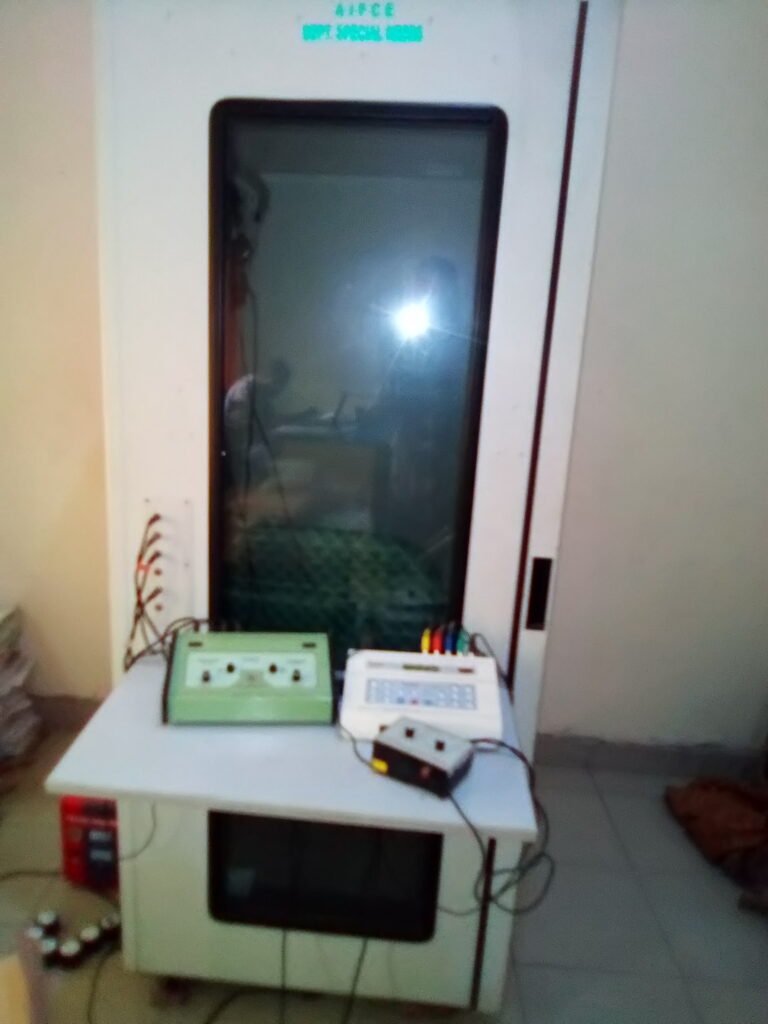
Featured image: Onwuka Glory, A Hearing Test Machine, CC0 1.0; resized for display.

General health education; sudden hearing loss requires immediate assessment.
Discover more from The Secret
Subscribe to get the latest posts sent to your email.