
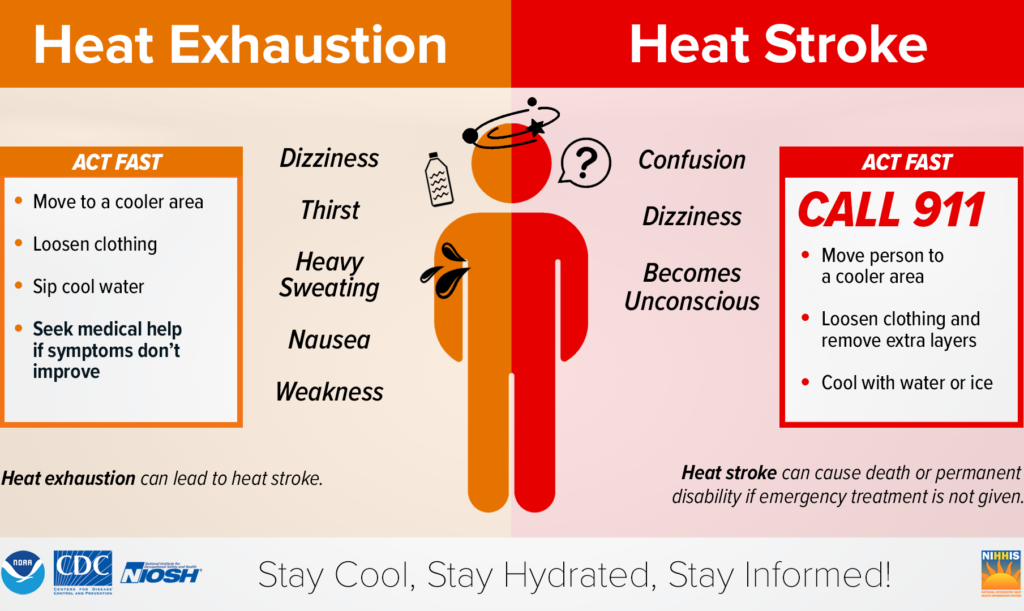
Heat-related illness can develop during exercise, outdoor work or prolonged exposure to hot indoor and outdoor environments. Early symptoms can resemble dehydration or ordinary fatigue, but a serious heat illness may progress rapidly. Recognizing a change in mental status and starting emergency care promptly are especially important when heat stroke is suspected.
Heat exhaustion often involves heavy sweating, weakness, headache, nausea and dizziness. Move the person to a cool place, remove unnecessary clothing, cool the skin and arrange medical advice or assessment. Offer small sips of cool water only if fully alert and able to swallow safely. Confusion, slurred speech, seizures or collapse during heat exposure suggest possible heat stroke: call local emergency services immediately and begin rapid cooling. Do not give anything by mouth to someone with impaired consciousness.
| Feature | Heat Exhaustion | Possible Heat Stroke |
|---|---|---|
| Alertness | Usually alert | Confusion, seizure or impaired consciousness may occur |
| Other signs | Weakness, nausea, dizziness, sweating | Severe overheating, neurological changes; sweating may continue |
| Immediate action | Stop exposure, cool and arrange medical assessment | Call emergency services and start rapid cooling |
| Oral fluids | Small sips if alert and swallowing safely | Do not give oral fluids to a person with impaired consciousness |
Understand How The Body Handles Heat
The body continually produces heat through metabolism and physical activity. It normally releases heat through several processes, including evaporation of sweat and transfer of heat to the surrounding environment. When environmental temperatures rise, the body’s ability to lose heat can become more limited. High humidity makes evaporation less effective, while physical exertion increases the amount of heat that needs to be released.
A hot environment is therefore not the only consideration. Workload, direct sunlight, clothing, air movement, humidity, access to cooling and individual health can all influence the overall heat burden. Someone exercising vigorously may develop a dangerous illness under conditions that another person tolerates during light activity.
Sweating also involves water and electrolyte losses. These losses can contribute to circulatory strain, but dehydration and heat illness are not identical. A person may experience overheating even when they have been drinking fluids. Our dehydration guide explains how fluid loss can affect the body and why symptoms alone do not establish its severity.
Heat exhaustion and heat stroke differ in their severity and clinical implications. Heat stroke involves dangerous overheating with dysfunction of the central nervous system. This is not merely a more uncomfortable form of ordinary tiredness. It is an emergency that can damage multiple organs.
Do not assume that the body will adapt simply by continuing an activity through warning symptoms. Stop exposure and assess the person. A timely response matters more than determining the precise environmental temperature or assigning a diagnostic label before taking appropriate action.
Recognize Heat Exhaustion
Heat exhaustion can develop when prolonged heat stress and sweating create substantial physiological strain. Possible symptoms include headache, weakness, dizziness, nausea, thirst and substantial sweating. Some people develop muscle discomfort or reduced urine output. Symptoms can begin gradually during a demanding activity or become apparent when a person stops.
Consider a fictional outdoor worker who has been lifting materials for several hours on a hot day. They become unusually tired, dizzy and nauseated but remain alert, answer questions appropriately and can swallow safely. These observations warrant stopping the activity, moving to a cooler environment, starting cooling and arranging appropriate medical evaluation. They should not be encouraged to finish the shift.
The appearance of the skin is not enough to determine severity. A person with heat exhaustion may sweat heavily, but sweating can also continue during heat stroke. Similarly, an individual may not show every symptom described in an educational guide.
Our exercise intensity guide describes why workload should be assessed relative to the individual. During heat exposure, an otherwise manageable workload may become much more demanding. Fatigue that is unusual for the activity deserves attention rather than automatic dismissal.
If symptoms persist, worsen or include vomiting, seek urgent medical care. People with medical conditions or other risk factors may need assessment sooner. If confusion, seizures, collapse or other emergency features develop, treat the situation as possible heat stroke or another emergency. Do not wait for an exact temperature reading to decide whether to act. The person’s mental state, breathing and overall condition matter.
Recognize Heat Stroke And Call Emergency Services
Heat stroke is a life-threatening medical emergency. It can occur during demanding physical activity or during prolonged exposure to environmental heat without intense exercise. Older people, individuals with certain medical conditions and others who have limited access to cooling may be particularly vulnerable to non-exertional heat stroke.
A critical distinction is the appearance of neurological dysfunction. Confusion, unusual behavior, difficulty speaking clearly, seizures or loss of consciousness in a person exposed to significant heat are serious warning signs. Body temperature may be extremely elevated, but first aid should not depend on obtaining a particular thermometer result.
A person with heat stroke can still be sweating. The idea that their skin must always be dry is an unsafe simplification. Exertional cases in particular may involve profuse sweating. Likewise, a person does not need to become unconscious before the emergency response is warranted.
Call the local emergency number immediately when heat stroke is suspected. In the United States this is 911; readers elsewhere should use the emergency service for their location. Provide the location, heat exposure, current responsiveness and any cooling measures already underway.
Our fainting first aid guide explains why collapse and altered responsiveness require assessment of normal breathing. If someone is unresponsive and not breathing normally, begin CPR and use an AED if available, following dispatcher instructions.
Heat stroke can progress quickly and cause serious injury or death. Do not leave the affected person alone, give fever-reducing medicine as a substitute for cooling, or wait to see whether confusion resolves. Emergency assistance and effective cooling need to begin promptly.
Provide First Aid For Suspected Heat Exhaustion
Stop exercise or work immediately and move the person away from the heat. An air-conditioned environment is useful when available, but shade, air circulation and other cooling measures can help while a more suitable location is arranged. Avoid making someone who is dizzy walk a long distance without assistance.
Help them rest in a comfortable safe position. Remove unnecessary outer clothing or equipment when appropriate. Apply cool wet cloths, wet the skin or use another suitable cooling method. Fans may support evaporative cooling when used appropriately with skin wetting.
If the person is fully alert, can swallow normally and is not vomiting, small frequent sips of cool water may be appropriate. A suitable electrolyte-containing drink may be useful after prolonged heavy sweating, depending on the circumstances and medical restrictions. Do not force large quantities of fluid or give salt tablets. Our daily water intake guide discusses why hydration requirements vary and why excessive intake can also be harmful.
Arrange medical evaluation or advice, particularly when the symptoms are significant or the person has relevant health risks. Occupational guidance from CDC’s National Institute for Occupational Safety and Health advises medical evaluation for workers experiencing heat exhaustion. If care is not accessible or symptoms worsen, use emergency services.
Observe the person for changes in responsiveness, speech or breathing. A cooling plan that seemed appropriate for an alert person must change immediately if they develop signs of possible heat stroke.
The aim is not to restore enough energy for immediate return to activity. Continuing work or exercise may worsen the problem. Stop exposure, support cooling and obtain the appropriate level of medical care rather than using temporary improvement as proof that it is safe to resume.
Start Rapid Cooling For Suspected Heat Stroke
Emergency cooling is particularly time-sensitive. After activating emergency services, move the person to a cooler location if this can be done safely. Remove unnecessary clothing and equipment. Start cooling immediately while following instructions from the emergency dispatcher.
Cold-water immersion can provide rapid cooling in exertional heat stroke when it is feasible and can be performed safely, particularly in organized athletic or occupational settings with trained personnel. An impaired person must have their airway protected and be continuously supervised. Do not place an unresponsive individual in water if you cannot safely maintain their airway.
When immersion is unavailable or unsafe, wet the skin or clothing with cool or cold water, circulate air and apply cold wet towels. Cold packs around areas such as the neck, armpits and groin can supplement cooling when appropriate. Do not delay available cooling while trying to assemble an ideal setup.
Stay with the person. Reassess breathing and responsiveness, and follow dispatcher instructions if the condition changes. If a person is not breathing normally, resuscitation takes priority, with additional helpers supporting cooling where feasible. Do not give oral fluids to someone who is confused, unconscious or otherwise unable to swallow safely.
Our first aid preparedness guide can help households and workplaces plan access to emergency equipment and contact information. Heat emergencies also require access to water, suitable cooling resources and a plan for obtaining emergency help.
A thermometer may provide additional information if available, but a peripheral temperature reading cannot safely rule out dangerous internal overheating. Do not postpone emergency cooling or medical assistance to obtain a measurement. The appropriate response is guided by the exposure and clinical warning signs, not a numerical threshold that a bystander must confirm first.
Distinguish Heat Cramps, Fainting And Muscle Breakdown
Heat-related conditions are not limited to exhaustion and stroke. Painful muscle cramps may occur during or after demanding activity in hot environments. The person should stop the activity, move to a cooler setting and obtain appropriate advice if symptoms are severe or persistent. People with medical restrictions affecting fluids or sodium need individualized guidance.
Heat-associated faintness may occur during prolonged standing or when standing suddenly, particularly when heat adaptation is incomplete. However, not every collapse in hot weather is a simple heat faint. A cardiac problem, heat stroke or another medical emergency can produce similar findings. Check responsiveness and breathing, and obtain appropriate assistance.
Rhabdomyolysis is a potentially serious condition involving muscle breakdown. Heat stress and unusually demanding exertion can contribute. Severe muscle pain, significant weakness or dark tea- or cola-colored urine after exertion warrant urgent medical assessment. A person may not experience every characteristic symptom.
Our delayed-onset muscle soreness guide describes the ordinary discomfort that can follow unfamiliar exercise. That discomfort should not be used to dismiss unusually severe symptoms, weakness or dark urine. Stop activity and obtain medical care when a serious muscle problem is suspected.
A person with recurrent cramps should not automatically begin concentrated electrolyte supplements. The circumstances, diet, workload and medical history matter. Similarly, a person who becomes dizzy during activity should not continue simply because they suspect low fluid intake.
The practical distinction is between an ordinary symptom that settles with appropriate measures and warning features that require medical evaluation. Heat can contribute to several medical problems simultaneously, so a single explanation should not be assumed when the person’s condition is deteriorating.
Identify Risk Factors Before Heat Exposure
Heat risk varies among individuals and environments. Older adults, young children, pregnant individuals, people with some chronic health conditions and those taking medicines that affect temperature regulation or fluid balance may require additional precautions. People who work or exercise outdoors can also face substantial risk because of the combination of exertion and environmental heat.
Housing and work conditions matter. An apartment without effective cooling can become dangerous during prolonged hot weather, even if the person is not exercising. Outdoor workers may face restricted access to shade, rest breaks or drinking water. Athletes may feel pressure to complete a session despite early warning symptoms.
Check local heat advisories and consider humidity, direct sunlight, workload, clothing and available cooling. A weather forecast’s air temperature alone does not fully describe the heat burden experienced during activity.
Our cycling guide and walking guide explain how to choose manageable activity routes. On hot days, a shorter route near cooling resources or a change of activity time may be more appropriate than following the original plan.
Discuss heat precautions with your healthcare professional if you have a condition requiring fluid restriction or use medication that could affect your response to heat. Do not stop prescribed medicines independently. A clinician can help determine whether the usual routine needs modification.
A useful heat safety plan also includes checking on people who may have difficulty recognizing symptoms or obtaining help. Arrange access to cooler spaces and a reliable way to contact emergency assistance. Preparation should account for actual circumstances rather than assuming that everyone can avoid heat simply by drinking more water.
Plan Hydration, Rest And Acclimatization
Gradual acclimatization allows the body to adapt to repeated heat exposure, but it does not eliminate risk. For someone beginning outdoor work or training in warmer conditions, the first sessions should reflect the new environment. Avoid immediately attempting the workload normally performed in cooler weather.
A reasonable plan may involve shorter or less demanding sessions, regular breaks in a cooler area and gradual adjustments based on how the person tolerates the conditions. Employers and organized sports programs should use appropriate heat safety procedures, trained supervision and relevant occupational or sporting guidance.
Water should be readily accessible. Prolonged heavy sweating may also require consideration of electrolytes and food. Requirements differ with exposure, health and workload. Drinking excessive quantities in an attempt to prevent all heat illness can be dangerous, and hydration alone does not guarantee safe body temperature.
Our potassium guide explains why concentrated electrolyte products are not appropriate for everyone, particularly when medical conditions or medicines affect electrolyte handling. Do not treat a fixed supplement regimen as universal heat protection.
Consider a fictional beginner planning to exercise at midday. The forecast indicates significant heat, and the route has little shade. A more appropriate choice might be an earlier session, a shorter duration or indoor activity in a cooler setting. If conditions are unsuitable, postponing exercise is reasonable.
Clothing and equipment should balance heat release with protection needed for the activity. Do not remove required occupational protective equipment without an approved safety procedure; instead, adjust the work plan with appropriate oversight.
The strongest prevention strategy is a combination of suitable environment, manageable workload, fluid access, rest, acclimatization and recognition of warning signs. No single product substitutes for these measures.
Return To Activity Only When It Is Appropriate
Temporary symptom improvement after cooling does not establish complete recovery. Following a heat exhaustion episode, rest and avoid immediate return to demanding activity or heat exposure. Seek professional guidance about when it is appropriate to resume, particularly if symptoms were significant, recurred or required treatment.
Heat stroke requires emergency medical treatment and subsequent follow-up. The return to work, sport or other demanding activity should be guided by the treating clinicians and relevant occupational or sports medical procedures. Do not follow a generic online timetable after a serious heat illness.
Record the circumstances of the event when possible: activity, environmental conditions, approximate symptom onset, mental status changes, cooling measures and medical treatment. This information can help the healthcare team and supervisors identify relevant precautions.
Our recovery guide describes how training workload can be adjusted around recovery. That general advice is not a replacement for medical clearance after a serious illness. The person’s condition must take priority over a planned exercise schedule.
Review what made the exposure difficult to manage. Perhaps the activity was unusually strenuous, shade was unavailable, protective equipment increased heat burden or a new environment was introduced too quickly. Address practical barriers before attempting another similar session.
The essential distinction remains simple: heat exhaustion requires stopping exposure, cooling and appropriate medical assessment; suspected heat stroke requires emergency assistance and immediate rapid cooling. When neurological symptoms appear, do not wait for certainty. Early recognition and prompt action can be crucial, and prevention begins before the person enters the hot environment.
Frequently Asked Questions
Can a person with heat stroke still sweat?
Sweating can continue, especially in exertional heat stroke. Dry skin is not a requirement.
What is the most important heat stroke warning sign?
Confusion, unusual behavior, seizures or impaired consciousness during heat exposure are emergency warning signs.
Should I wait for a temperature of 104°F?
Do not delay emergency care or cooling to confirm a specific temperature when heat stroke is suspected.
Can someone with heat exhaustion drink water?
Small sips may be appropriate when the person is fully alert, can swallow safely and is not vomiting.
What if cold-water immersion is unavailable?
Begin other safe cooling measures immediately, including wetting the skin and circulating air, while awaiting emergency help.
Is drinking more water enough to prevent heat stroke?
Hydration is only one part of prevention; heat exposure, workload, rest and cooling also matter.
Can I resume exercise once dizziness disappears?
Stop heat exposure and obtain appropriate advice about return to activity, rather than resuming immediately.
- CDC/NIOSH: Heat-Related Illnesses
- CDC: Heat And Athletes
- CDC: About Heat And Your Health
- National Weather Service: Heat Illness
Featured image: National Weather Service, CDC and NIOSH, Heat Exhaustion Versus Heat Stroke; U.S. public domain government work. The infographic uses 911, the U.S. emergency number. Use your local emergency number elsewhere.

General first aid education, not individualized diagnosis or treatment.
Discover more from The Secret
Subscribe to get the latest posts sent to your email.