
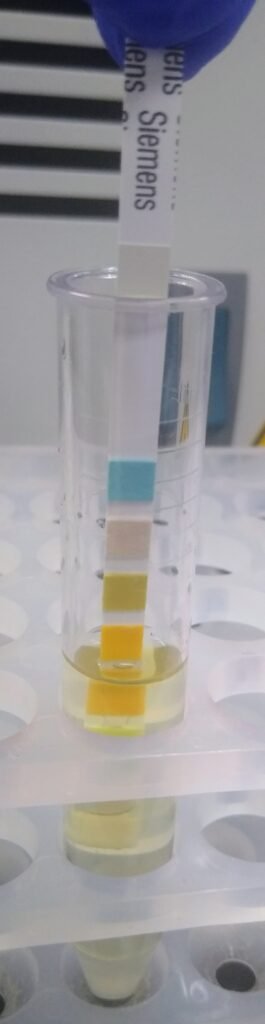
Urinalysis is a group of tests performed on a urine sample. It can provide information about urinary tract symptoms, kidney-related findings and other aspects of health. Because the test includes several different observations, a report may contain both descriptive terms and numerical results. This guide explains how samples are collected, what the measurements can mean and why abnormal findings must be interpreted with symptoms and clinical history.
Urinalysis may include a visual inspection, chemical dipstick testing and microscopic examination. Depending on the reason for testing, a report may include specific gravity, pH, protein, blood, glucose, ketones, nitrites, leukocyte esterase and cells. Follow the laboratory’s collection instructions. A positive dipstick is not a complete diagnosis; further testing may be needed.
| Finding | What It Can Help Assess |
|---|---|
| Specific Gravity | Relative urine concentration |
| pH | Urine acidity or alkalinity |
| Protein | Possible protein excretion, with confirmation when indicated |
| Blood | Heme-related chemical finding, with microscopy when appropriate |
| Nitrite And Leukocyte Esterase | Findings relevant to bacteria or inflammation, not definitive diagnosis |
| Microscopy | Cells, casts, crystals and other elements |
Understand The Purpose Of A Urine Test
The kidneys help regulate fluid and electrolyte balance and remove various waste products from the blood. Urine contains substances that are excreted through this process, along with water. Examining a sample can provide useful information, but it does not directly describe every aspect of kidney function or the cause of every urinary symptom.
A clinician may request urinalysis when a person has painful urination, visible blood in the urine, a relevant medical condition or another clinical concern. The test may also be part of selected medical monitoring. Different purposes can require different measurements or sample types.
For example, a person with possible urinary tract infection may have a urine test looking for findings relevant to infection. Another person may have urine protein assessed as part of kidney-related monitoring. Although both tests use urine, the clinical questions differ and the recommended follow-up may also differ.
Our medical checkup guide explains why knowing the reason for a test is useful. Ask whether the test is investigating symptoms, reviewing a previous finding or monitoring a known condition. The answer can help you understand which results are most relevant.
The MedlinePlus urinalysis overview describes physical, chemical and microscopic components. Not every laboratory performs all of them on every sample. Read the actual report and discuss its purpose with the healthcare professional rather than assuming that a short panel means the assessment is incomplete.
Collect A Clean-Catch Sample Correctly
The sample collection procedure matters because cells, bacteria and other material from outside the urinary tract can affect the findings. Follow the actual instructions supplied by the laboratory or healthcare service. A clean-catch midstream sample is commonly requested for certain investigations, including possible urinary tract infection.
Wash your hands and use the supplied collection container. Follow the specific instructions for cleaning the relevant area. Begin urinating into the toilet, then collect the requested midstream amount without touching the inside of the container or lid. Finish as directed, close the container securely and label or return it according to the laboratory’s procedure.
Some tests use different collection methods. A first-catch sample can be relevant for particular investigations, while a timed collection may be required for another question. Do not automatically use a midstream procedure when the laboratory has provided different instructions.
The MedlinePlus clean-catch collection guide provides additional information. If you are menstruating, have difficulty collecting the sample or have accidentally contaminated the container, tell the healthcare team. They can advise whether the sample remains appropriate or another collection is necessary.
Our food safety guide discusses how contamination can occur during ordinary handling. Laboratory specimens have their own procedures, but a similar principle applies: avoid contact with surfaces that are not part of the intended collection process. Follow the laboratory’s transport and storage instructions rather than leaving a sample for an unspecified period at room temperature.
Interpret Appearance, Specific Gravity And pH
The physical examination of urine may include its color and clarity. Many ordinary factors can affect appearance, including fluid intake, food, medicines and the time of collection. Cloudiness or discoloration may also be associated with medical findings. Appearance alone cannot establish the presence or absence of infection or kidney disease.
Specific gravity provides information about the relative concentration of urine. A more concentrated sample can produce a different result from a dilute sample. Fluid intake, the kidney’s concentrating ability and certain substances in the urine may influence the measurement. A clinician interprets it according to the reason for testing and accompanying findings.
Urine pH describes its acidity or alkalinity. Dietary factors, metabolic circumstances, infections and the handling of a specimen can influence pH. The result is not an overall measurement of whether the person’s body is acidic or alkaline. Do not use urine pH to select an unproven cleansing or alkalizing treatment.
Our dehydration guide explains why urine color can be a useful observation but cannot precisely establish fluid status. Deliberately consuming large quantities of water before a urine test may change the concentration and make some findings more difficult to interpret. Follow the instructions for the actual test.
A fictional adult receives a report describing dark urine and relatively high specific gravity. They provide information about recent illness, fluid intake and the reason for testing rather than assuming that these observations independently prove dehydration. A clinician can evaluate the full report and decide whether additional assessment is needed.
Understand Protein And Albumin Findings
Protein detected in urine can be relevant to kidney assessment, although the clinical significance depends on the amount, the method, the sample and other circumstances. A routine dipstick is generally a semiquantitative test and is particularly responsive to albumin. It does not provide a precise measurement of every type of protein.
A clinician may recommend a quantitative measurement, such as a urine albumin-to-creatinine ratio, to clarify an appropriate finding. This ratio helps account for differences in sample concentration and is used in particular kidney-related assessment frameworks. It is not identical to the dipstick result, and the units and reference categories should remain attached to the report.
Temporary circumstances, including recent illness or strenuous activity, can sometimes influence urine findings. A persistent abnormality may have different implications. Do not independently dismiss a result because you can identify a possible temporary explanation. Follow the recommended confirmation or follow-up.
Our exercise intensity guide describes how physical workload varies among activities. If you performed unusually demanding exercise around the time of collection, mention it to the healthcare professional. They can decide whether it is relevant.
The American Family Physician review of urinalysis explains the role of quantitative confirmation for urine protein findings. The goal is to determine whether the finding is persistent and medically significant, not merely to remove the abnormal flag from a report.
A urine protein measurement should not be interpreted as proof that a person is eating too much protein. Ordinary dietary intake and protein detected in urine represent different biological questions. Discuss dietary restrictions only when clinically indicated.
Understand Blood, Glucose And Ketones
A dipstick result for blood may reflect the presence of red blood cells or other substances containing heme. A positive chemical result may therefore require microscopy or another appropriate assessment. The amount of visible discoloration does not necessarily correspond to the degree of a dipstick finding.
Blood in urine can have several causes. Infection, stones, other urinary tract conditions and contamination from outside the urinary tract are among possible explanations. Visible blood should be assessed medically, even when there is no pain. A positive dipstick should not automatically be assigned to one cause without appropriate evaluation.
Glucose can appear in urine under particular circumstances, including elevated blood glucose or changes in the way the kidneys handle glucose. Some medicines intentionally increase glucose excretion. Urine glucose is not equivalent to a diagnostic fasting plasma glucose test. Our fasting glucose guide explains the distinction between diagnostic blood measurements and other monitoring methods.
Ketones are substances associated with fat metabolism. Their presence can occur in different circumstances, including prolonged inadequate food intake or particular medical conditions. In a person with diabetes who becomes unwell, ketones can be medically important and may require urgent treatment according to an individualized sick-day plan.
Severe vomiting, deep or difficult breathing, confusion or marked deterioration requires emergency assessment. Do not delay care to compare urine strip colors at home. The interpretation of glucose and ketones should reflect the actual symptoms, medicines and clinical context. A person who has been given a diabetes emergency plan should follow it rather than substituting general urinalysis information.
Interpret Nitrites And Leukocyte Esterase Carefully
Nitrites can be detected in some urine samples when particular bacteria convert nitrate to nitrite. Not all bacteria perform this conversion, and the test conditions can influence whether nitrites are detected. A negative result therefore does not exclude every urinary tract infection.
Leukocyte esterase is associated with white blood cells and can provide evidence relevant to inflammation or infection. Contamination and other circumstances can affect the finding. A positive result is not sufficient on its own to determine the cause or select an antibiotic.
A person with painful urination, urinary frequency or other relevant symptoms may need a clinical assessment. A healthcare professional may consider the urinalysis pattern, medical history and whether a urine culture is appropriate. The significance of bacteria in urine without symptoms can differ from their significance in someone who has a symptomatic infection.
The MedlinePlus leukocyte esterase resource describes why additional examination can be useful. A urine culture investigates bacterial growth under specified laboratory conditions and may help guide treatment in appropriate cases. It is a different investigation from an immediate dipstick.
Our preventive care guide emphasizes that tests should answer a defined clinical question. Do not seek antibiotic treatment solely because a home strip has changed color, and do not use leftover antibiotics. Unnecessary treatment can cause harm and may not address the actual cause.
If urinary symptoms occur with fever, pain in the side or back, vomiting or marked illness, seek prompt medical care. Severe symptoms, confusion or rapid deterioration require emergency assessment. A seemingly reassuring dipstick should not override concerning symptoms.
Learn What Urine Microscopy Can Show
Microscopic examination involves observing elements in an appropriately prepared urine sample. Depending on the procedure and findings, the report may describe red blood cells, white blood cells, epithelial cells, casts, crystals or microorganisms. These categories provide different information and should not be treated as interchangeable.
Red blood cells can help clarify a chemical finding for blood. White blood cells may be relevant to inflammation or infection. Epithelial cells can originate from different parts of the urinary tract or reflect contamination during collection. Their significance depends on the type and amount, as well as other findings.
Casts are structures formed within kidney tubules and may provide information relevant to particular kidney-related processes. Different types of casts have different implications. Crystals can occur in various circumstances, and their presence does not automatically establish that a person has a kidney stone.
A fictional report contains epithelial cells and bacteria. The clinician considers the collection method, symptoms and other results before deciding whether the sample suggests contamination, infection or another possibility. Repeating a correctly collected specimen may be appropriate in some situations, but that decision should reflect the clinical context.
The MedlinePlus epithelial cells resource explains how microscopy can complement chemical testing. If a report uses terms such as cells per high-power field, keep those units and the laboratory’s reference information intact.
Do not attempt to identify cells using an ordinary household microscope or photograph of urine. Professional examination requires suitable preparation, equipment and interpretation. Understanding the report’s terminology can help you ask useful questions without replacing clinical analysis.
Recognize Sample Limitations And When To Seek Care
A result can be influenced by specimen concentration, collection quality, timing, storage and test-specific limitations. Some findings need confirmation because a screening method is not designed to establish a diagnosis on its own. An appropriate repeat test or different method may clarify the original observation.
If you notice visible blood in urine, persistent urinary symptoms, difficulty urinating or another concerning change, obtain medical advice. Fever with side or back pain, vomiting or marked illness can indicate a more serious problem requiring prompt assessment. Seek emergency assistance for severe deterioration, confusion, collapse or inability to obtain necessary urgent care safely.
Pregnancy and certain medical conditions can change the significance of urinary findings and the appropriate investigation. Follow individualized clinical advice. Do not apply a home testing routine intended for a healthy nonpregnant adult to every situation.
Our first aid preparedness guide describes why household supplies cannot replace professional assessment of a serious medical problem. A urine strip can offer a limited measurement, but it cannot establish whether an illness is becoming dangerous.
When contacting a healthcare professional, report the symptoms, timing, medicines and relevant medical history. Include the actual report if available and explain how the specimen was collected. Do not delay contacting a service because you want to repeat the test several times.
The purpose of testing is to support appropriate care. A person with symptoms may need assessment despite an unremarkable report, while someone with an abnormal finding but no symptoms may need individualized follow-up rather than immediate self-treatment. Preserve the distinction between laboratory observations and medical decisions.
Prepare For A Follow-Up Conversation
After receiving results, identify the tests actually performed and ask which findings are clinically relevant. Preserve the report’s units, reference intervals and collection date. If a clinician recommends another test, ask which question the new investigation is intended to clarify.
For instance, a fictional patient has protein detected by dipstick and receives a recommendation for quantitative testing. They record the separate test names rather than comparing the two results as if they were the same measurement. Another person with a positive blood dipstick may need microscopy or other assessment depending on the circumstances.
Our liver test guide explains why panels contain complementary measurements. Urinalysis uses a different specimen and methods, but the same interpretive principle applies. A single flagged result does not necessarily explain every other finding.
Bring your medication list, relevant symptoms and information about collection conditions. Tell the clinician about an unusual fluid intake, recent illness or other relevant change, without assuming it invalidates the report.
Do not modify prescribed medicines, begin an extreme hydration routine or start an antibiotic independently in response to a result. If there are specific instructions about repeat testing or treatment, retain them and follow the agreed plan.
A urinalysis is most useful when it answers a defined question and leads to an appropriate next step. Knowing what the chemical and microscopic measurements represent can help you participate in that discussion. Clinical interpretation and follow-up remain essential when abnormalities or persistent symptoms are present.
Frequently Asked Questions
What does urinalysis measure?
It can examine urine appearance, chemical properties and microscopic elements depending on the test ordered.
Do I always need a clean-catch sample?
Follow the laboratory’s specific instructions; different tests may use different collection methods.
Can a negative nitrite test rule out UTI?
It cannot exclude every infection. Symptoms and other findings matter.
Does urine protein prove kidney disease?
Protein can have several explanations and may need quantitative confirmation.
Is urine glucose the same as fasting blood glucose?
They are distinct measurements and cannot be interpreted as interchangeable diagnostic tests.
What if I see blood in my urine?
Arrange appropriate medical assessment, even if there is no pain.
Can a home dipstick replace medical testing?
Home strips have limited uses and cannot establish every diagnosis or treatment decision.
- MedlinePlus: Urinalysis
- MedlinePlus: Clean Catch Urine Sample
- AAFP: Office-Based Urinalysis
- MedlinePlus: Blood In Urine
Featured image: Spicy, Dipstick Urinalysis, CC BY-SA 4.0; resized under the same license.

General health education, not individualized diagnosis or treatment.
Discover more from The Secret
Subscribe to get the latest posts sent to your email.