
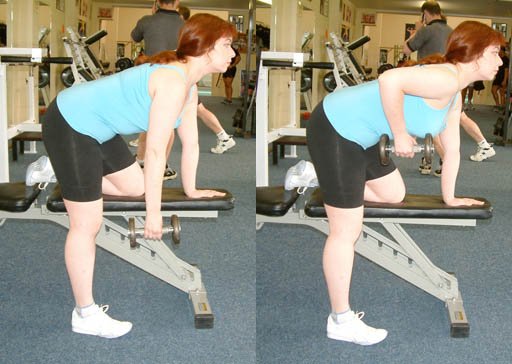
A dumbbell row is a pulling exercise in which the arm moves a weight toward the torso against gravity. It can complement pushing exercises and help develop strength around the back and shoulder. Beginners do not need a heavy dumbbell or a complicated training setup. They need an appropriate variation, stable support if required, a controlled movement and a plan for gradually adapting the workload.
For a beginner, a supported one-arm row can reduce the balance and trunk-control demands of the exercise. Use a secure bench or another support intended for exercise, hinge comfortably at the hips, let the weight hang under the shoulder and draw the elbow back toward the side of the body. Lower it slowly. Use a load you can control, and stop for sharp pain, numbness or instability.
| Variation | Primary Setup | Consideration |
|---|---|---|
| One-Arm Supported | Secure bench or suitable support | One arm works while the other supports |
| Two-Arm Bent-Over | Standing hip hinge | Greater sustained trunk demand |
| Chest-Supported | Suitable inclined bench | Reduced need to maintain a free-standing hinge |
| Resistance Tubing Row | Manufacturer-approved secure setup | Different resistance and anchoring demands |
Understand The Muscles And Movement Pattern
A dumbbell row involves movement at the shoulder and elbow as the weight is lifted. The muscles that contribute to moving the upper arm backward and controlling the shoulder blade participate along with the elbow flexors. Depending on the variation, the trunk and lower body also help maintain a stable position.
Commonly discussed muscles include the latissimus dorsi, portions of the trapezius, rhomboids, posterior deltoid and elbow flexors. Their relative contributions change according to elbow direction, torso angle, range and other variables. A list of muscles worked does not mean every repetition trains all of them to exactly the same extent.
The dumbbell is pulled upward against gravity. This makes the torso position relevant to the direction of resistance relative to the body. A row performed with a relatively horizontal trunk has a different resistance relationship from a movement performed while standing upright and pulling the weight vertically.
Our beginner push-up guide describes a pressing exercise. A row can offer a complementary pulling movement within a broader resistance program. However, one pushing exercise and one pulling exercise do not automatically address every strength goal or shoulder-related concern.
For a beginner, the practical objective is to learn to move a suitable resistance toward the body without losing control of the chosen support position. It is not necessary to isolate a single back muscle or create a particular sensation. A useful repetition is one that matches the intended movement and remains manageable.
Choose The Appropriate Row Variation
A one-arm supported dumbbell row typically uses a bench or suitable exercise support to assist with the body position while the other hand holds the weight. Some versions support one hand and one knee on a bench, while others keep both feet on the floor. The choice depends on mobility, comfort, the support and the ability to handle the load safely.
A two-arm bent-over row uses both hands to lift resistance while the person maintains a hinged position. This arrangement generally requires more sustained control of the trunk and hips because there is no free hand for support. It may be appropriate after learning a comfortable hip hinge, but it is not a compulsory progression.
A chest-supported row uses a bench designed to support the torso at an appropriate angle. It can reduce some demands of maintaining a free-standing hinge, though the setup still needs to allow controlled arm movement and safe handling of the dumbbells.
Our hip hinge guide explains how to practise the bending pattern without a challenging load. If the hinged position itself is difficult, begin with a variation that reduces this demand or choose another suitable resistance exercise.
A person with a recent injury, surgery, balance problem or movement restriction should follow individualized guidance. A supported exercise does not guarantee suitability for every back or shoulder condition. Discuss alternatives with an appropriate exercise or rehabilitation professional when needed. Choose the variation that supports the actual training purpose, not the variation that appears most advanced.
Select A Safe Support And Suitable Dumbbell
Before setting up, check that the bench or equipment is intended for the proposed exercise. A bench used for seated lifting may have instructions about load capacity, positioning and adjustments. These limits may include the combined demands of the user and resistance. Do not assume that a household chair or unstable table can replace a suitable exercise bench.
Clear the area around the support. A dumbbell should be placed where it can be picked up and returned without striking the bench or another object. Avoid placing loose weights in a walking route. If using adjustable equipment, check that its locking mechanism is engaged according to the manufacturer’s instructions.
Our dumbbell comparison explains the differences between equipment types. The dimensions of an adjustable model can affect available movement space, and a fixed dumbbell may offer a different grip or handle size. Select based on the load, comfort and safe handling, rather than assuming the heaviest adjustable range is necessary.
For the initial practice, choose a resistance that feels clearly manageable. The ability to hold the weight for one moment does not establish that it can be controlled throughout a complete set. Our grip strength guide describes how gripping demands can influence ordinary function and exercise.
A fictional beginner owns dumbbells of several sizes. They select the lightest useful option while learning the movement and return the weight to a stable position between attempts. If the setup or grip becomes awkward, they adjust the equipment instead of trying to compensate by moving faster. A safe setup is an important part of technique.
Perform A Supported One-Arm Dumbbell Row
Start with a suitable bench and a manageable dumbbell. One common setup places the supporting hand on the bench and uses a stable stance. Depending on the bench and your ability, one knee may also rest on the bench. Keep the support position comfortable and predictable. If transferring to this position is difficult, use a different suitable variation.
Hinge forward at the hips as needed, allowing the knees to bend comfortably. Keep the trunk controlled rather than deliberately forcing the back into an exaggerated arch. Hold the dumbbell in the working hand with the arm directed down toward the floor. Establish a comfortable starting position before beginning the pull.
Draw the elbow backward so the weight moves toward the side of the torso. Use a range that allows the shoulder and trunk to remain controlled. Do not attempt to pull the elbow as high as possible regardless of discomfort or loss of position. At the top of the repetition, pause briefly if useful, then lower the weight smoothly.
The Mayo Clinic dumbbell row demonstration provides additional guidance on a bent-over rowing movement. The exact setup can vary. Follow any individual instructions from a coach or clinician.
Breathe throughout the movement and avoid prolonged deliberate breath-holding. Repeat only while the support, grip and weight path remain manageable. When the set is complete, return the dumbbell to a safe resting position before changing sides. Beginners should learn both the lifting motion and the process of safely entering and leaving the setup.
Control The Shoulder And Elbow Path
Different elbow directions change how the exercise is organized. Keeping the elbow relatively close to the side may create a different movement from rowing with the elbow farther outward. These are not universally good or bad positions. The appropriate choice depends on the intended variation and the person’s shoulder comfort and available range.
Avoid forcing the upper arm into an extreme position to achieve a greater apparent range. For an introductory row, use a comfortable path that allows the weight to move predictably toward the torso. A coach may recommend more specific adjustments when a particular training goal requires them.
The shoulder blade should be able to move naturally as the arm moves. It is not necessary to squeeze the shoulder blades together as forcefully as possible throughout every part of the repetition. Similarly, do not deliberately shrug the shoulder toward the ear to lift a heavier dumbbell.
A fictional learner notices that their torso rotates substantially each time the dumbbell rises. They try a lighter weight and a smaller controlled range, then compare the movement. If rotation remains difficult to control or discomfort occurs, a different supported variation may be appropriate.
Our stretching guide describes how mobility and preparation can serve different purposes. A row does not require forcing the shoulder into a greater range before every set. Select a comfortable movement and adjust it according to appropriate guidance.
The objective is not to eliminate all natural movement of the body. It is to keep the exercise consistent with its purpose, avoid abrupt compensations and maintain control of the load. This helps make repetitions easier to compare and reduces the temptation to count uncontrolled movements as successful progression.
Recognize Common Technique And Setup Errors
One difficulty is selecting too much resistance too soon. The learner may jerk the weight, lift the torso or rotate substantially to complete each repetition. Those movements can change the training demand. Reduce the resistance and check whether the intended pulling motion becomes easier to control.
Another difficulty is holding the dumbbell loosely or allowing the wrist to fold under the load. A comfortable grip and a predictable wrist position are useful for handling the equipment. If the handle is too thick, too slippery or otherwise unsuitable, consider another implement rather than gripping it through pain.
Pay attention to the support. If the bench moves, the supporting hand slips or the stance becomes unstable, stop and address the setup. Do not attempt to complete the remaining repetitions while balancing on equipment that is not secure.
A limited range is not necessarily an error. Some people can perform a comfortable partial row but cannot control a larger movement. Begin with a suitable range and increase it only if appropriate. Pulling farther than your available shoulder motion may create unnecessary strain.
Our warm-up guide explains the value of preparing for the intended activity. A few light repetitions can help assess whether the setup feels manageable. They are not a reason to continue when the movement produces concerning symptoms.
Use practical feedback: can you repeat the same movement without abrupt changes, and can you put the weight down safely? If not, change the resistance, support or variation. Persistent difficulty may warrant guidance from a qualified professional. A technique correction should make the activity more manageable, not introduce another problem.
Design Sets, Repetitions And Rest Around Your Goal
A general strength routine can include rowing alongside other suitable exercises. A healthy beginner who can already use the supported variation safely might try one or two sets of six to ten manageable repetitions on each side. This is an illustrative starting point rather than a requirement. Some people may need fewer repetitions or a different exercise altogether.
Start with the side and setup that you can control, then perform an appropriate amount on the other side. A difference in ability between sides may influence exercise selection and should not be interpreted as a diagnosis. New weakness or a substantial unexplained change deserves medical evaluation.
Rest long enough to regain control before the next set. A fixed short rest interval may be unsuitable if the grip, breathing or support position has not recovered. For a beginner learning technique, rest can be more valuable than trying to fit as many repetitions as possible into a short period.
Our beginner resistance training guide provides a wider framework for exercise selection. Include appropriate lower-body, pressing and other movements according to the program’s purpose. The row should not dominate the entire session simply because it trains several muscles.
Our rest-day guide discusses workload and recovery. A person’s work, other exercise and everyday activities may also challenge the arms and back. Adjust the weekly schedule to the total demand. An exercise that is manageable once may become difficult if repeated too frequently without adequate recovery. Consistency and suitable progression matter more than an ambitious initial schedule.
Progress Resistance Without Losing Control
Keep a record of the chosen variation, dumbbell weight, repetition count and approximate effort. If the support changes substantially, note that change too. A chest-supported row and a free-standing row may not be comparable simply because the same dumbbell is used.
Imagine a fictional adult performing two sets of eight repetitions with a manageable weight. After several sessions, the same workload becomes easier and remains controlled. They could add a repetition to each set, increase the weight by a small available amount or maintain the workload if it already meets their goal. Changing all variables at once would make the resulting workload harder to evaluate.
Our progressive overload guide explains the general principle of increasing an appropriate training demand over time. The actual increment should reflect the available equipment and the person’s response. A jump from a very light dumbbell to one twice as heavy may be too large even when the original weight feels easy.
If the next available weight is unsuitable, consider using the existing weight for a few additional controlled repetitions or changing another appropriate variable. Do not deliberately make the support unstable to create extra difficulty. The aim is a meaningful increase in the intended training demand rather than unnecessary risk.
Allow the training plan to change when work, illness or other circumstances affect recovery. If grip becomes the limiting factor, avoid continuing after the weight can no longer be held safely. A useful training record should help select the next manageable step, not create pressure to increase the load at every session.
Recognize Symptoms And Use Appropriate Alternatives
Normal muscular effort can occur during a row, and temporary fatigue may follow an unfamiliar exercise. Sharp pain, numbness, tingling, instability or a sudden loss of function is different. Stop the movement if concerning symptoms occur, and seek appropriate assessment when symptoms persist or recur.
Our muscle soreness guide explains the distinction between ordinary delayed soreness and symptoms that require attention. Severe muscle pain, marked weakness or dark urine after exercise requires urgent medical assessment. Chest pain, fainting or severe breathing difficulty during exercise requires emergency assistance.
Someone who cannot tolerate a supported row may benefit from a different movement under appropriate guidance. A suitable seated cable row or resistance band exercise may offer a different setup. Our equipment guide discusses how different resistance sources affect handling and practical setup. A band must be secured and used according to its instructions; improvised anchoring can create hazards.
The Mayo Clinic resistance tubing row demonstration provides another example of a pulling movement. Do not assume that a different implement is automatically suitable for a medical problem. A clinician or qualified trainer can help choose an appropriate alternative.
A productive routine includes exercises that meet the person’s actual needs. The dumbbell row is useful for many strength programs, but completing it is not a requirement for good health. Learn a manageable variation, control the load, allow appropriate recovery and adapt the program when the movement is not suitable.
Frequently Asked Questions
What muscles do dumbbell rows work?
They involve muscles of the back, shoulder and elbow flexors, with other muscles supporting the chosen position.
Is a supported row easier for beginners?
Support can reduce some trunk and balance demands when the setup is suitable.
Should I use one or two dumbbells?
Choose according to the variation, available support and your ability to control the movement.
How heavy should a beginner’s dumbbell be?
Select a manageable resistance that allows consistent control throughout the set and safe handling afterward.
Must I pull the weight to my chest?
Use an appropriate elbow path and comfortable range rather than forcing a fixed endpoint.
Can a resistance band replace a dumbbell?
A suitably secured band can provide a pulling exercise with different resistance characteristics.
What if my shoulder hurts during rows?
Stop painful movements and obtain appropriate advice for persistent or concerning symptoms.
- Mayo Clinic: Bent-Over Row With Dumbbell
- Mayo Clinic: Bent-Over Row With Resistance Tubing
- CDC: Adult Activity Guidelines
Featured image: GeorgeStepanek (attributed), Dumbbell Bent Over Row, CC BY-SA 3.0; resized under the same license.

General fitness education, not individualized rehabilitation advice.
Discover more from The Secret
Subscribe to get the latest posts sent to your email.