
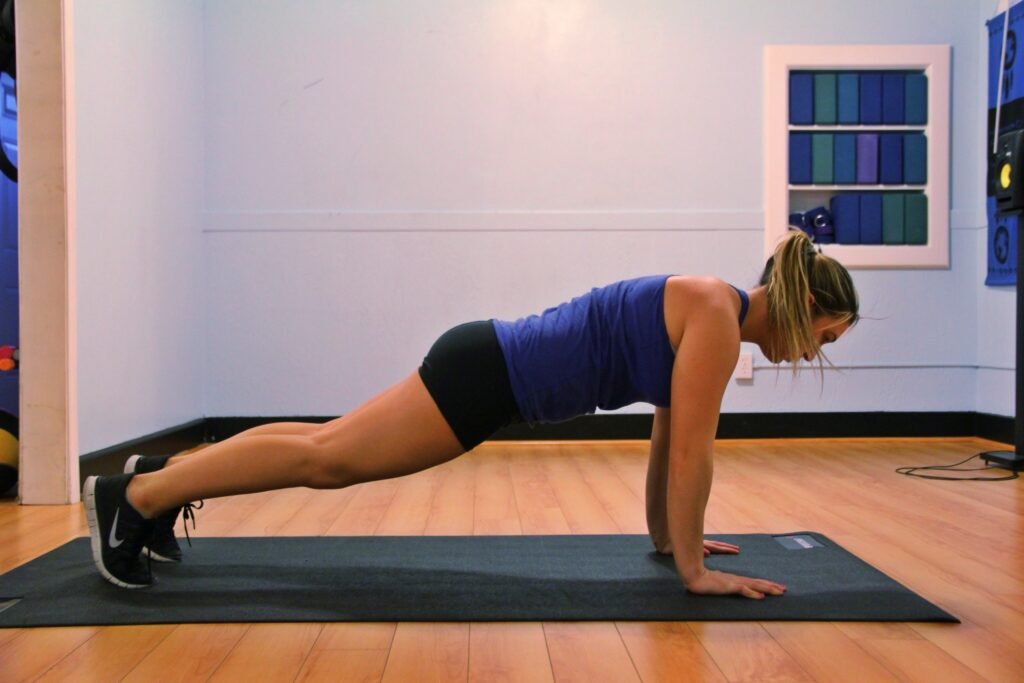
A plank is a resistance exercise in which you maintain a controlled body position against gravity. It can be performed using a wall, a suitable elevated support or the floor. The main objective is maintaining the intended position while breathing normally, not holding the exercise for as many minutes as possible. This guide explains how to choose a suitable version and build a realistic core training routine.
Begin with a wall or stable incline plank if floor versions are too challenging. Position your hands or forearms securely, maintain a comfortable controlled alignment of the trunk and hips, and breathe throughout the hold. Start with brief manageable efforts, rest, and progress only when you can maintain control. Stop for pain, dizziness or other concerning symptoms.
| Variation | Support | Key Consideration |
|---|---|---|
| Wall | Hands or forearms on solid wall | Standing stability |
| Incline | Secure elevated support | Support height and traction |
| Knee-Supported | Forearms or hands and knees | Safe floor transfers |
| Forearm | Forearms and toes | Elbow comfort and trunk control |
| High Plank | Hands and toes | Wrist and shoulder tolerance |
Understand What A Plank Trains
The plank is commonly described as an isometric exercise because the principal task is maintaining a position rather than repeatedly moving through a large range. Muscles of the abdomen, back and hips contribute to controlling the trunk, while the shoulders, arms and legs support the body according to the variation. The precise demands change with the position of the support points and the angle of the body.
Core training is not limited to the abdominal muscles visible at the front of the torso. The trunk participates in movement and force transfer during many everyday activities. Exercises that involve control of the trunk can therefore serve a useful purpose within a broader resistance program. A plank is one option, not a comprehensive test of core function.
Our hip hinge guide describes a movement in which the trunk and hips need to be coordinated while bending and lifting. A plank involves a different task, emphasizing sustained control rather than the same kind of movement. Both may be useful depending on the person’s program.
A longer plank hold is not necessarily proof of better performance in every activity. Endurance in a particular static position differs from strength during movement, and neither measure alone describes overall fitness. Before adding the exercise, identify whether the goal is introductory trunk control, a component of a balanced routine or preparation for a more specific training task.
A useful plank should be challenging enough to serve that purpose but manageable enough to permit controlled breathing and a safe transition out of the position.
Choose A Starting Variation That Fits Your Ability
A wall plank allows a person to stand while placing the hands or forearms against a suitable wall. Because the body is relatively upright, it may require less support through the arms and trunk than a floor version. This can be a useful starting point for someone who can stand safely but is not ready to transfer to the floor.
An incline plank uses a securely fixed or structurally suitable elevated surface. As the support becomes lower, the body’s position changes and the exercise may become more demanding. Do not use movable furniture, an unstable table or an unsecured exercise platform.
A knee-supported floor plank shortens the distance between the support points compared with a version supported by the toes. It still requires the ability to get down to and up from the floor safely. A standard forearm or high plank places more of the body in a suspended position between the upper and lower support points.
Our push-up guide explains how wall, incline and floor arrangements can alter the difficulty of another bodyweight exercise. The same principle can guide plank selection, although the movement and training objective are different.
If you have a recent injury, surgery, significant balance limitation or a prescribed exercise restriction, obtain individualized guidance. A less demanding variation is not automatically safe in every medical circumstance. Select an exercise that you can enter, maintain and leave safely. There is no requirement to reach a floor plank if another appropriate variation already meets your goal.
Practise A Wall Or Incline Plank
Select a clear area with predictable footing and a solid wall or suitable exercise support. For the wall version, stand facing the wall and position the hands or forearms at a comfortable height. Step back only far enough to create a manageable leaning position. The support should remain secure when pressure is applied.
Allow the body to form a comfortable line appropriate to the position. The goal is to avoid sudden sagging or excessive arching through the trunk. Keep the knees and elbows comfortably positioned rather than deliberately forcing the joints into extreme positions. Breathe normally while maintaining the hold.
When ending the exercise, step closer to the wall or support in a controlled manner and return to a comfortable standing position. Avoid pushing off suddenly if that would affect balance. Rest before repeating the exercise.
For an incline version, check the support height and surface before starting. Place the hands securely, step back into the chosen position and maintain control. A lower support is not an automatic progression if it creates difficulty with grip, footing or transfers.
Imagine a fictional beginner who holds a wall plank comfortably for ten seconds and then returns to standing. After resting, they repeat the same exercise. They do not move to a low bench simply because the first hold was successful. Instead, they establish consistent technique over several sessions before deciding whether additional demand is useful.
Our beginner strength training guide explains why manageable introductory sessions can help establish a routine. For a plank, brief practice at an appropriate angle may be more useful than one prolonged effort that ends in a loss of control.
Learn A Knee-Supported Forearm Plank
The knee-supported forearm plank can be appropriate for someone who can transfer to the floor safely and tolerate support through the knees and forearms. Use a stable surface and a suitable mat if needed for comfort. Do not place the elbows on an object that may shift while the body is supported.
Begin on the knees and forearms with the elbows positioned approximately beneath the shoulders. Move into a comfortable position so that the trunk and thighs form a controlled line. Avoid allowing the hips to drop abruptly or deliberately lifting them into an unrelated position to extend the hold.
Breathe steadily. A beginner may find it useful to hold for only a few seconds, then lower or return to a resting position. The amount of time should reflect actual control rather than a predetermined minimum. If the supporting areas become painful or the movement is difficult to exit, stop and choose another variation.
The Mayo Clinic core strength guide describes a modified plank as one of several core exercises. The modified version can reduce some demands, but it should still be selected according to the person’s circumstances.
Our stretching guide explains why available movement range and the intended activity matter. If a person finds kneeling uncomfortable, forcing the knee position is not necessary for core training. A wall plank, appropriately supported alternative or another professionally recommended exercise may be more suitable.
The quality of a hold includes the transition into and out of the exercise. Practise these transitions as part of the routine, rather than concentrating exclusively on the time spent in the final position.
Compare The Forearm Plank And High Plank
A standard forearm plank commonly supports the upper body through the forearms and the lower body through the toes. The elbows are placed at a comfortable position near the shoulders, and the body is held in a controlled alignment. A high plank instead supports the upper body through the hands with the arms extended comfortably.
The two arrangements distribute demands differently. A high plank may require greater tolerance of wrist extension, while a forearm plank places pressure through the elbows and forearms. The trunk position and individual proportions also affect the effort. Neither version is universally easier or better.
For the forearm version, establish the upper-body support before extending the legs. Use a manageable stance and avoid deliberately rounding or arching the spine to an extreme. Hold only while breathing and controlling the body remain possible. Lower the knees or return to another safe position to end the set.
For the high plank, place the hands securely on the surface and extend the legs as appropriate. Keep the elbows comfortably extended without forcing them beyond a suitable range. The shoulder blades can move naturally as the shoulders support the position. If wrist or shoulder discomfort occurs, stop and review the variation.
Our dumbbell row guide discusses how different support arrangements influence upper-body resistance exercises. A plank uses a different movement pattern but similarly requires equipment and positioning suited to the individual.
A floor version is optional. Someone who cannot safely perform one may still develop useful trunk strength using another appropriate exercise. Choose the support arrangement based on control and comfort rather than treating the most demanding version as the only valid result.
Avoid Common Plank Technique Problems
A common difficulty occurs when the hold continues after the person can no longer maintain the intended trunk position. The hips may drop, the shoulders may become uncomfortable or the person may begin holding their breath. These are useful signals to end the set rather than reasons to force additional time.
Another difficulty is excessive tension in areas that are not intended to be challenged. For example, someone may deliberately squeeze the jaw or force the neck backward while looking forward. Use a comfortable head position and normal breathing. The exact angle will vary according to the plank variation and individual anatomy.
Do not assume that the trunk must look perfectly straight in a photograph. The spine has natural curves, and a suitable position accounts for the person’s body proportions. The objective is consistent control without unnecessary extreme positions. A qualified professional can help adapt the exercise when a particular movement concern exists.
Our warm-up guide explains that preparation should match the intended exercise. A short easier plank or another suitable movement can help assess readiness. A warm-up does not justify continuing through pain.
If you record a video for technique feedback, do so only from a safe setup and do not allow the camera to distract you from the exercise. Review broad changes such as loss of control or a shifting support. A recording cannot establish the internal condition of a joint or diagnose the cause of discomfort.
The most useful correction is often reducing the duration, choosing a higher support or using another suitable variation. A plank that can be performed comfortably and repeatedly is more valuable than maintaining a difficult position with increasingly uncontrolled compensation.
Plan Hold Time, Sets And Recovery
Plank training can be organized using hold duration, the number of holds and the variation used. A healthy beginner who can perform a suitable version safely might start with one or two holds lasting five to fifteen seconds, with enough rest to regain comfortable control. These figures are examples, not a prescription for everyone.
The duration of a hold should end before the person loses the ability to maintain the intended position or breathe normally. A person who can manage a brief controlled hold has already established a useful starting point. There is no need to test maximum duration during every session.
For illustration, a learner completes three comfortable ten-second holds with adequate rest. The following week, they repeat the same arrangement and notice that control has improved. They may choose to add a few seconds to a hold or maintain the current workload. They do not need to lower the support and increase the hold time simultaneously.
Our progression guide describes the general principle of increasing an appropriate training demand gradually. In a plank, changing the angle or support points can substantially alter the demand even when the hold time remains unchanged.
Our recovery guide explains why the overall training schedule matters. Planks may be combined with pushing, pulling and lower-body exercises that already involve trunk and shoulder control. The amount of additional work should reflect that total demand.
A simple record can include variation, number of holds, duration and perceived effort. The goal is to identify a manageable routine, not to establish a competition against a timer. If the current exercise serves your objective, repeating it may be appropriate.
Understand Side Planks And Other Core Alternatives
A side plank changes the direction of the trunk-control challenge by supporting the body in a side-oriented position. Modified versions can use the knees, while other versions support the body through the feet. This exercise may create substantial demands on the supporting shoulder and balance, even when the hold duration is short.
Someone learning side planks should select a suitable variation and obtain practical guidance when the setup is unfamiliar. Use an appropriate surface and avoid forcing a painful shoulder position. Do not assume that a person who can perform a front plank can automatically perform a side plank safely.
Other core exercises can involve controlled movement rather than a sustained hold. Examples include suitable bridging or four-point kneeling exercises, depending on the person’s mobility and medical circumstances. The Mayo Clinic core strength resource describes several options. A complete program can include different movement and control demands rather than relying solely on prolonged plank holds.
Our squat guide and hinge guide describe exercises that also involve trunk coordination. The amount of isolated core training needed depends on the wider routine and the individual’s purpose.
For a person who cannot tolerate upper-body support, another exercise may provide a more suitable challenge. A qualified trainer or clinician can help choose an appropriate option. The plank is not a necessary treatment for back pain, a requirement for abdominal appearance or a guarantee of injury prevention.
Select the exercise according to the function or training goal it is intended to support. An appropriate alternative is preferable to repeatedly attempting a position that causes discomfort or cannot be controlled.
Recognize Warning Signs And Build A Balanced Routine
Temporary muscular effort during a suitable plank is expected, but sharp pain, unusual numbness, instability or dizziness are reasons to stop. Persistent or recurring symptoms deserve appropriate assessment. If you have been given instructions after surgery, injury or a medical diagnosis, follow those instructions rather than substituting an online core exercise program.
Chest pain, fainting or severe breathing difficulties during activity require emergency help. Our fainting guide explains why collapse during exercise warrants emergency assessment even if the person appears to recover. A target hold time should never take priority over responding to concerning symptoms.
Core exercise can complement suitable aerobic and resistance activity. Our home workout guide explains how to organize a broader routine. Include movements that address your actual goals and abilities rather than focusing exclusively on a single exercise.
Progress can be measured by consistent control, comfortable breathing, confidence entering and leaving the position or the ability to repeat a suitable workload. A person does not need to hold a plank for several minutes to demonstrate that the exercise is useful.
Review your setup periodically. A wall or incline arrangement may remain the best choice even after fitness improves, particularly when floor transfers are unsuitable. If a more demanding variation is relevant, make the change gradually and consider recovery.
A thoughtful plank routine emphasizes an appropriate support, controlled effort, ordinary breathing and a safe end to each hold. These practical decisions support sustainable strength training more effectively than chasing a fixed duration or forcing everyone to use the same version.
Frequently Asked Questions
Can a beginner start with a wall plank?
A wall version can be suitable when standing and using a secure support are safe.
Is a forearm plank better than a high plank?
The support arrangements create different demands. Choose according to comfort, control and your goal.
How long should I hold a plank?
Start with a brief manageable hold and end it before control or breathing deteriorates.
Can planks remove abdominal fat in one area?
A plank is a strength exercise and cannot selectively remove fat from a particular area.
Should I hold my breath?
Maintain normal breathing and follow any individualized clinical exercise instructions.
What if my wrists or shoulders hurt?
Stop painful movements, review the variation and obtain advice for persistent symptoms.
Must I eventually perform a floor plank?
A suitable wall, incline or other core exercise can remain appropriate if it meets your needs.
- Mayo Clinic: Exercises To Improve Core Strength
- Mayo Clinic Health System: How To Strengthen Your Core
- CDC: Adult Physical Activity Guidelines
Featured image: Jaykayfit, Plank, CC BY-SA 3.0; resized under the same license. Illustrative high plank.

General fitness education, not individualized rehabilitation advice.
Discover more from The Secret
Subscribe to get the latest posts sent to your email.